THE CORE MECHANIC
"The Lights Lower, A System Agnostic Grimdark RPG Mechanic"
Not all fiends show their true shape when shrouded in shadow. And not all intents are clear when the festival lamps dim to a simmer...
At a point of great stress, fear, or foreboding, a Game Master may announce that "The Lights Lower", then announce by how many degrees. The Degree is set as at least the number of Player Characters in the encounter, +1 Degree for each encounter before this one today. The Game Master will then hold out an offering dish, plate, dice tray, sack, or beckoning hand.
Player Characters must sacrifice a metagame altering mechanical resource until the degree of the Lowering Lights is met, or until the PC's unanimously agree they are done sacrificing (or run out of fungible resources). These resources can be as follows:
- D&D: Inspiration
- Shadowdark: Luck
- Daggerheart: Hope
- Eldritch Borg: Sanity
- Pirate Borg: Devil's Luck
- Mork Borg: Omens
- Any System: Temporary 1 Point Reduction of a Statistical Modifier.
If the degree is not met, the danger multiplies! This can come in the form of a GM's discretion and creativity, or the following table can be rolled on. If the condition is already met, a new roll can be made.
- Creatures sprout wings and gain a flying speed comparable to their movement speed!
- Creatures glow with unnatural light -- their attacks now count as magical damage!
- Creatures gain interdimensional telepathy, and will plan their attacks around the above-table, real-world planning of players!
- A presumed Ally of the Player Characters steps from out of the shadows, beside the threat, revealing their betrayal!
- Creatures have set a deadly trap, prompting characters to make a moderately difficult saving roll or be immobilized for the first round of combat!
- Creatures are revealed to have once been Allies of the Player Characters, either through mutation, infection, corruption, or betrayal! First attacks will be disadvantageous to the Player Characters, either in the form of harder attack rolls or lessened damage.
- Creatures spark with volcanic malformities, whose incendiary attacks now set characters on fire if they don't pass an easy saving roll.
- Creatures will fight to the death, no matter what, focusing their energy on killing as many Player Characters as possible!
- Creatures billow with frost-borne fear tactics, whose cryo-attacks now freeze characters if they don't pass an easy saving roll.
- Creatures grow in size by one size, gaining any related benefits, or a flat +1 to all applicable statistics.
- Curses from dead casters fill the air, strangling and preventing all magic for the duration of the encounter.
- Broken promises litter the floor, and all psychological tests and saving throws are automatically failed.
- Environment swells with disgusting refuse, all terrain becomes difficult.
- Perilous pitfalls sneer with hunger, damage-dealing hazards deal an extra x2 dice of damage.
- Shadows lengthen, snuffing all light sources, and plunging the encounter into total darkness.
- Corrosive miasma fills the space, and all ranged attacks automatically miss.
- Fires have started in two points of the space, and will spread unless snuffed out!
- Environment is infected with a necrotic sickness, all healing effects are cancelled and negated.
- Blinding light, evil in its saccharine glare, spills from the cracks in the environment! Treated as darkness, only, effects that negate darkness don't work.
- Threats in the space are doubled, at the Game Master's discretion.
Failsafe Refund: If the degree is not met, the GM offers to refund all sacrificed resources. If the players accept the refund, the lights lower fully and the danger table is rolled. If they decline the refund, they keep whatever partial protection they bought but the remaining unmet degrees still trigger danger.
Example in Play:
GM: As you bravely repel down into the castle's oubliette, The Lights Lower by 5 Degrees.
Fighter: Not again! I will contribute my last Inspiration.
Warlock: As will I.
GM: Alright, that's only 2, and you have three more to go.
Paladin: Fine, I will chip in this Inspiration I earned last session. Is there anything else I can offer?
GM: You may burn 2 from your Charisma modifier until your next rest, to squint and hunch through the gloom...
Paladin: That's a hard bargain, but what choice do we have?
GM: Finally, what will you do, Rogue?
Rogue: I have no Inspiration, and I won't be sacrificing my skills just to be ambushed in the next room! I say we stand and fight with everything we have.
GM: Would you like me to refund everything and allow the lights to lower?
Players: Yes!
GM: Okay. (Passes back resource tokens) Now, waiting at the bottom of the oubliette is the polite blacksmith from the tavern, crossbow in hand with his band of x4 Bandits! "Nothing personal," he hollers, "just business!" He fires a shot right at you, Rogue!
Designer's Note
The designer originally devised this mechanic to strengthen horror storytelling, but found it was becoming too much of a crutch for atmosphere. Atmosphere needs to come from oration, tension, and -- most abstractly -- vibes. As a way to spice up a crawl or a mystery, though, this mechanic creates a storytelling opportunity for sacrifice. With the failsafe refund, characters face a game theory choice: go into a more dangerous encounter weaker, or go into a mystery encounter stronger, as dictated by meta resource management.
THE LIGHTS LOWER IN KORMOR KIRAK
In the Gothic Gaslamp Fantasy city of Kormor Kirak, The Lights Lower is not merely metaphor. The city's vast network of gas lamps -- installed by order of Vampire Queen Kiraline herself over the past three centuries -- is woven into the very fabric of the metropolis. These lights are maintained by the Lamplighter's Guild, though few know that the Guild answers ultimately to the Queen's inner circle. When The Lights Lower, it is the city itself that responds.
The lowering may be the result of the Comet Chamber's influence -- that strange astronomical phenomenon that warps reality in unpredictable ways when it grows near. It might be the Lich Cult's shadow rituals seeping into the material world, their necromantic rites unraveling the boundaries between dimensions. Or perhaps it is the Queen's own will asserting dominion, her three-century-old power bleeding through the infrastructure like ink through parchment. Whatever the cause, the effect is unmistakable: the gas sconces dim, the shadows move wrong, and the rules of the world grow negotiable.
The Lights Lower manifests differently depending on where in Kormor Kirak the characters find themselves. Here are some specific narratives for different locations:
Castle Torony Piros
The massive fortress-palace of Queen Kiraline sits at the city's heart, crowned with a thousand gas sconces. When The Lights Lower there, the effect is subtle but profoundly wrong. The sconces dim to a sickly amber -- like old candlelight seen through disease-filled eyes. Shadows on the castle walls move independently of their sources, sliding across stone like liquid. In the throne room, the Queen's shadow grows larger and darker than her physical form, sometimes seeming to gesture independently. The marble floors appear to ripple as if submerged in water that only the darkness perceives. Guards report feeling watched from directions where no one stands. The air grows cold despite the gas flames burning hotter. Those who've experienced it describe a sensation of the castle walls leaning inward, listening.
Kereskedo Marketplace
The great marketplace of Kereskedo is always loud -- merchants hawking goods, crowds haggling, musicians busking in corners. When The Lights Lower, the merchant lanterns hanging from every stall begin to gutter and sputter, despite having been freshly lit moments before. The crowds' murmurs change in tone and cadence; conversations that were previously about trade and gossip shift toward paranoia and suspicion. Merchants' voices become sharper, more aggressive. The crowd's shuffling footsteps synchronize into something almost rhythmic, unsettling in its uniformity. The smell of roasted chestnuts and exotic spices gives way to something like copper and burnt paper. Vendors report that customers' eyes seem to glow faintly in the flickering light -- though the effect vanishes if looked at directly. The marketplace maintains its crush of bodies, but the quality of the crush changes from casual market traffic to something more purposeful, more predatory.
The Dungeons Beneath Castle Torony
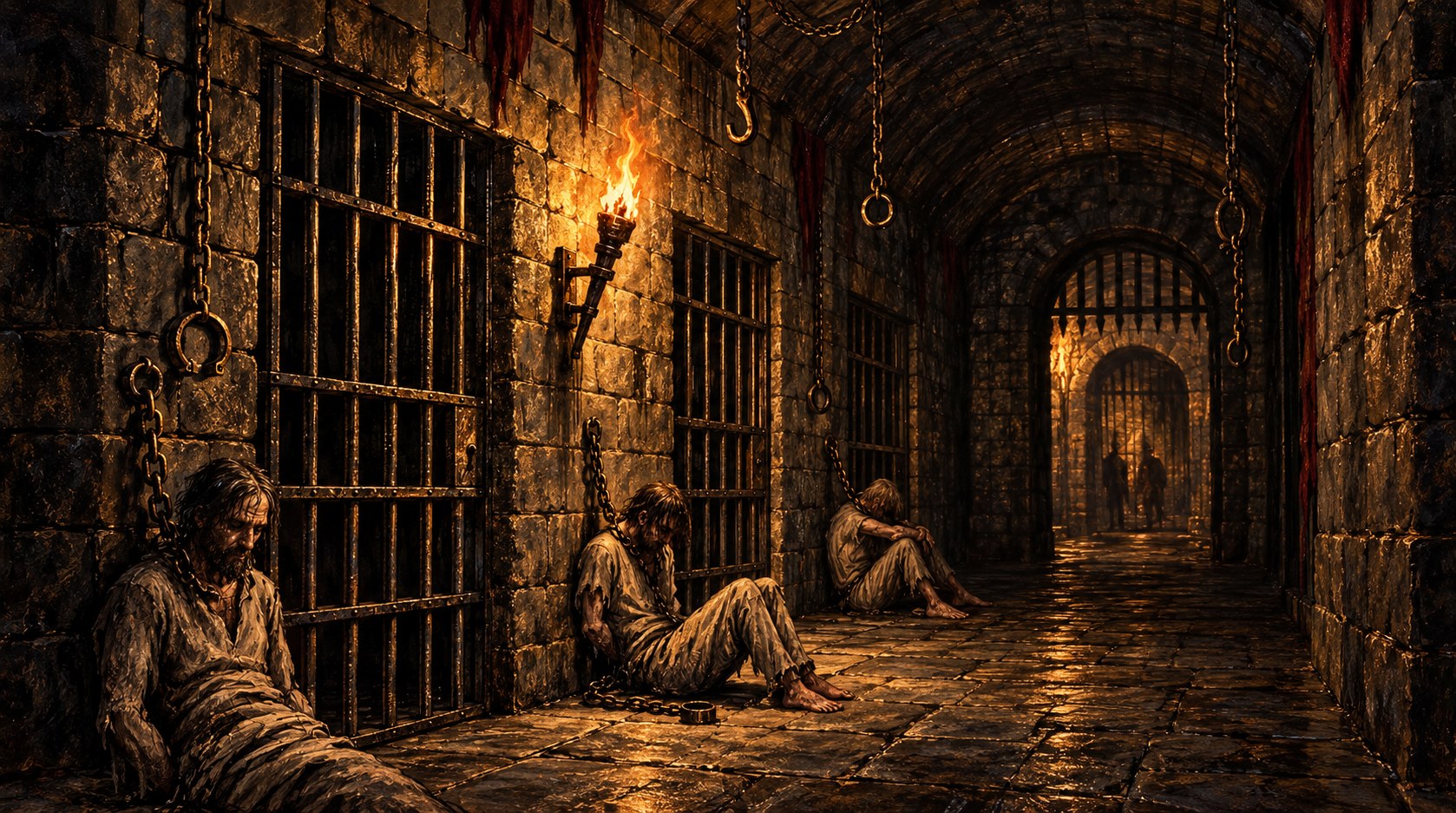
The dungeons are lit by ancient iron sconces filled with alchemical torches -- flames that should never dim. When The Lights Lower in the depths, those torches extinguish one by one in sequence, as if an invisible hand is traveling through the corridors snuffing them out. The sound of keys jingling in Istvan the Jailer's office grows muffled, then stops entirely. Istvan himself -- always a chattering, corpulent presence -- falls utterly silent. Prisoners report that the darkness between torches becomes thicker than it should be, as if the shadows themselves have weight and substance. Whispers echo from cells that have been empty for years. The stone walls seem to contract slightly, and the air becomes difficult to draw into the lungs. Most disturbing: the torch-fire that remains visible seems to move downward into pools of darkness below, as if gravity itself has redirected.
Hallaset Fields Cemetery
The sprawling cemetery on Kormor Kirak's eastern edge is always melancholic, but when The Lights Lower, it becomes actively hostile to living breath. Ground fog rises from between tombstones despite clear weather, thick and choking, carrying a scent of opened earth and preservation oils. The grave markers seem to shift position when viewed peripherally -- not dramatically, but enough to make navigation unreliable. The stone angels and memorial crosses cast shadows that are far too long and too dark, and those shadows sometimes don't match the angle of the fading light. The grass beneath one's feet grows slick, though not wet. Most disturbingly, the graves themselves seem to open -- not fully, just cracks in the earth spreading like fissures, revealing stone sarcophagi and wooden coffins below, as if the ground is breathing. The epitaphs carved into markers blur and shift when one tries to read them.
Eppy's Pub
Eppy's Pub is a warm refuge, famous for its roaring hearth and Eppy's stream-of-consciousness commentary on the day's events. When The Lights Lower, the hearth dims dramatically despite never being less than fully stoked. The flames turn a sickly purple-green color. Eppy -- a man who has never fallen silent for more than thirty seconds in living memory -- stops mid-sentence. Not as if he's made a conscious decision, but as if his voice has been stolen from him. His mouth continues moving, but no sound emerges. The pub's other patrons stop their conversations as well, turning toward the hearth with expressions of deep, inexplicable dread. The warmth from the fire becomes cold despite the flames appearing brighter. Shadows in the corners of the pub stretch impossibly long and seem to contain depths that shouldn't exist in a two-dimensional silhouette. The smell of pipe smoke and ale gives way to something like copper and lightning.
ETERNAL COURT DANGER TABLE VARIANTS
While the core d20 danger table applies universally, Kormor Kirak has its own unique dangers. Gamemasters may use this d12 table instead of rolling on the core table, or may roll on both tables and combine results for escalated encounters. These dangers are specific to The Eternal Court's dark setting and include threats unique to the city, the Queen, and the supernatural forces at work within her domain.
- Vampire Thralls in the Shadows: A cadre of the Queen's thralls -- humans who have drunk the royal blood and are bound to her will -- emerge from shadows and corners where none were visible moments before. They move with unnatural grace and coordination, clearly operating under a single unified command. The thralls will attempt to restrain and capture rather than kill, clearly receiving orders from somewhere unseen.
- Red Guard Patrol Arrives: A unit of the Queen's elite guard -- the Red Guard, identifiable by their crimson uniforms and silver insignias -- rounds a corner directly into the encounter. They are armed with both conventional weapons and alchemical grenades. They are not here by accident; someone has reported the characters' activities to the crown.
- Bone Sentinels Awakening: Animated skeletons crafted by the Lich Cult stir to life around the encounter area. These are not natural creatures but constructs, puppeteered by necrotic magic from a distance. They cannot be reasoned with or intimidated, and they prioritize stopping the characters above all else.
- The Queen's Voice Whispers: One randomly chosen character hears the voice of Queen Kiraline in their mind -- a presence like cold silk against their thoughts. She whispers secrets specific to that character, offers tempting bargains, or simply laughs at their predicament. The character must make a moderately difficult saving throw or become confused or paralyzed by indecision for 1d4 rounds. The Queen can see through this character's eyes for the duration of the encounter.
- Clockwork Mechanisms Go Haywire: The city's infrastructure -- whether gas pipes, hanging chains, mechanical doors, or alchemical pumps -- begins to malfunction violently. Furnaces vent scalding steam, pressure valves explode, hanging chains collapse, and gears grind loudly enough to cause pain. All terrain becomes difficult, and everyone in the area takes ongoing damage until they spend an action to disable the mechanism or flee the area.
- Necrotic Energy Surge: The boundary between the living world and the necrotic planes tears briefly. A wave of withering energy sweeps through the area, dealing damage to all living creatures and healing all undead. After this surge, undead creatures gain advantage on all saving throws and their attacks count as magical. Any character reduced to 0 hit points by this surge becomes a temporary wraith or specter for the duration of the encounter, still under the player's control but unable to affect the material world except to warn others.
- Lich Cult Ritual Interference: A coven of Lich Cult members nearby is performing a ritual, and the characters have blundered into the working space. The cultists prioritize completing their ritual over combat; they will summon creatures, cast area effects, and attempt to incapacitate rather than kill the party. If the ritual is not disrupted within 3 rounds, something emerges -- a portal, a summoned entity, a localized temporal distortion -- that affects the entire encounter area.
- Reality Fractures: The Comet Chamber's influence becomes temporarily visible. Cracks of otherworldly light appear in the air itself, and reality becomes unstable. Characters must make difficult saving throws or suffer disorientation; prone and confused enemies gain advantage on attacks as the characters struggle with spatial orientation. Any creature killed in this fractured space leaves behind a temporary rift that deals damage to those who pass through.
- The Betrayer Emerges: An NPC the party has trusted -- a patron, a contact, an informant, or even a companion -- reveals their true allegiance to either the Queen or the Lich Cult. They attack the party directly or work against them strategically, and they have knowledge of the party's capabilities and weaknesses.
- Shadow Hunger Manifests: The shadows in the area become predatory and hungry, seeming to reach toward the characters with semi-tangible appendages. Characters take damage equal to how many rounds they spend in shadow or darkness. The shadows cannot be fought directly but can be scattered by sustained light sources. However, light sources in this area burn twice as fast.
- The Lamplighters' Secret: The local gas lamps, rather than providing light, begin to leak a narcotic vapor that induces visions and paranoia. All characters within the area must make Constitution saving throws or become poisoned, suffering disadvantage on all rolls and speaking aloud their innermost fears and secrets.
- Temporal Distortion: Time becomes unreliable. Actions take unpredictable amounts of time to complete, initiatives reset mid-combat, or rounds occur out of order. The GM determines the specific nature of the distortion, but the end effect is that all plans become unreliable and combat becomes chaotic. Creatures native to Kormor Kirak (thralls, Red Guard, cultists) operate normally while the characters suffer disadvantage due to their confusion.
TYING THE LIGHTS TO THE ESCALATION TRACK
The Eternal Court campaign progresses through five distinct escalation phases, and The Lights Lower mechanic should intensify proportionally to reflect the campaign's growing darkness.
Phase 1: Shadow and Suspicion
In the earliest phase, when the characters are first learning about Kormor Kirak and the threats it contains, The Lights Lower might occur once per session, typically during critical moments or when the characters stumble upon evidence of the Queen's machinations. The base degree typically equals the number of player characters (3--4 usually). The failures feel manageable -- the darkness is disturbing but not yet catastrophic. The danger table rolls are relatively straightforward threats that the party can overcome with effort.
Phase 2: Web of Lies
As the characters begin to uncover deeper conspiracies and attract the attention of various factions, The Lights Lower might occur twice per session during major encounters or when the party enters significant locations. The base degree now equals the number of player characters plus 2. Enemies that emerge are more powerful, and the mechanical penalties from the danger table become more disruptive -- status effects that last longer, terrain hazards that are harder to escape, encounters with higher stakes.
Phase 3: The Broken Throne
By mid-campaign, when the party is actively working against the Queen's interests and the Lich Cult begins to make its presence known, The Lights Lower becomes a frequent occurrence -- possibly happening 3--4 times per session. The base degree equals the number of player characters plus the session number (Session 1 = PCs +1, Session 12 = PCs +12, etc.). Encounters now regularly include multiple rolled dangers, stacked effects, or the GM's creative intensification. The party begins to understand that The Lights Lower is not random but actively responding to their growth as threats.
Phase 4: The Crimson Ascendant
As the campaign reaches its climax with the Red Guard actively hunting the party and the Lich Cult's plans crystallizing, The Lights Lower becomes nearly constant in any encounter. The base degree equals the number of player characters multiplied by the escalation phase (Phase 4 = PCs × 4). Multiple danger table results should be rolled, combined, or used to create hybrid threats. The mechanic now represents the city itself turning against the characters -- the Queen's will made manifest through infrastructure and shadows.
Phase 5: The Final Descent
In the campaign's final phase, as the party confronts the Queen, the Lich Council, or whichever dark force they've chosen to oppose, The Lights Lower is effectively always in effect. The base degree equals the number of player characters × 5, making it nearly impossible to avoid sacrifice. The danger table should be heavily homebrewed by the GM at this point, creating encounters that feel uniquely tailored to the party's specific journey. The mechanic has evolved from a resource-management system into a thematic representation of the party's defiance against inevitable darkness.
WHEN TO CALL THE LIGHTS LOWER
The Lights Lower is most effective when used strategically rather than constantly. It works best at moments of genuine dramatic weight, when the party faces truly difficult choices or enters locations of significance. Here are specific triggers within The Eternal Court campaign:
Olivia's Journal Cases
Several of the cases from Olivia's Journal are natural triggers:
- "The Lamplighter's Daughter" -- When the characters investigate the disappearance of the Lamplighter's Guild director's daughter, The Lights Lower during their confrontation with the responsible party. The case involves uncovering a deliberate culling, which merits the mechanical and narrative weight of the lowering.
- "Flowers for the Feast" -- When characters discover the true purpose of the exotic flowers being cultivated by the Queen's botanists, The Lights Lower in the greenhouse or laboratory where they make their discovery. The flowers are tools of transformation, and their revelation demands escalation.
- "Voices in the Vaults" -- As the party explores the ancient vaults beneath the castle, The Lights Lower to reflect the increasing unreality of the deeper levels. Each descending level may trigger a new lowering with a higher base degree.
- "The Red Guard's Reckoning" -- When the party first directly confronts the Red Guard in combat (rather than fleeing or avoiding them), The Lights Lower as the Queen's elite forces make a coordinated move against the characters.
- "The Comet's Eye" -- During any scene where the Comet Chamber's influence becomes visible or felt, The Lights Lower to represent reality destabilizing under its weight.
Locations Prone to The Lights
Certain locations in Kormor Kirak are inherently unstable and more likely to trigger the mechanic:
- Castle Torony Piros, especially the throne room, the vaults, and the Comet Chamber itself
- The Dungeons beneath the castle, particularly the deeper levels where forgotten things are imprisoned
- Hallaset Fields Cemetery at night, or during any scene involving grave disturbance
- The Undercroft Markets, a black market area where reality itself seems negotiable
- Lich Cult Sanctuaries, whether hidden temples, abandoned churches, or network hubs
- The Lamplighter's Central Station, where the city's gas infrastructure is controlled
Story Beats That Warrant The Lights Lower
Beyond specific cases and locations, these narrative moments are appropriate triggers:
- First Major Betrayal -- When a trusted NPC reveals their true allegiance or turns against the party, The Lights Lower to emphasize the magnitude of the betrayal and the character's fall from grace.
- Discovery of the Queen's True Nature -- If the characters encounter the Queen directly or learn definitive proof of her immortality and power, The Lights Lower to represent reality warping under the weight of the truth.
- Activation of a Lich Cult Ritual -- Whenever the cultists execute a significant working or summoning, The Lights Lower to reflect the necrotic magic tearing at the fabric of the world.
- Investigation of a Major Crime Scene -- When the party examines the site of a significant murder or supernatural event, particularly one connected to the Queen or the Lich Cult, The Lights Lower to represent the lingering supernatural residue of the violence.
- Numerical Disadvantage Against Overwhelming Odds -- When the party faces an encounter where they are clearly outmatched in numbers or power level, The Lights Lower as a mechanical representation of the difficulty and the world recognizing the threat they face.
- Confrontation with Supernatural Entities -- Any direct combat against vampires, liches, wraiths, or other powerful supernatural beings should trigger The Lights Lower to emphasize their otherworldly nature and power.
SAFETY NOTE
The Lights Lower intensifies the horror and grimdark elements of The Eternal Court. The mechanic emphasizes desperation, sacrifice, and the possibility of failure -- themes that can be emotionally heavy.
Before implementing The Lights Lower in your campaign, discuss it during Session Zero. Explicitly cover:
- The mechanic's purpose: to create dramatic moments of choice and sacrifice rather than to punish the party randomly
- How the failsafe refund works and that players always have the option to rewind and accept the danger rather than sacrifice resources
- Which horror tropes will appear (betrayal, body horror, corruption, loss of autonomy) and whether any are off-limits for your table
- How the mechanic will be signaled (the GM literally holding out a hand or dish, or whatever ritual you establish)
- That players can always request the GM go easier on a specific aspect if they find themselves experiencing real distress
Refer players to the Session Zero Guide included in The Eternal Court Core Book for complete safety protocols. Remember that atmosphere comes from oration, tension, and vibes -- the mechanic enhances those elements but does not replace them. The best use of The Lights Lower is infrequent and purposeful, creating memorable moments rather than constant pressure.
For use with The Eternal Court: A Gothic Gaslamp Fantasy Supplement for Kormor Kirak, 1793