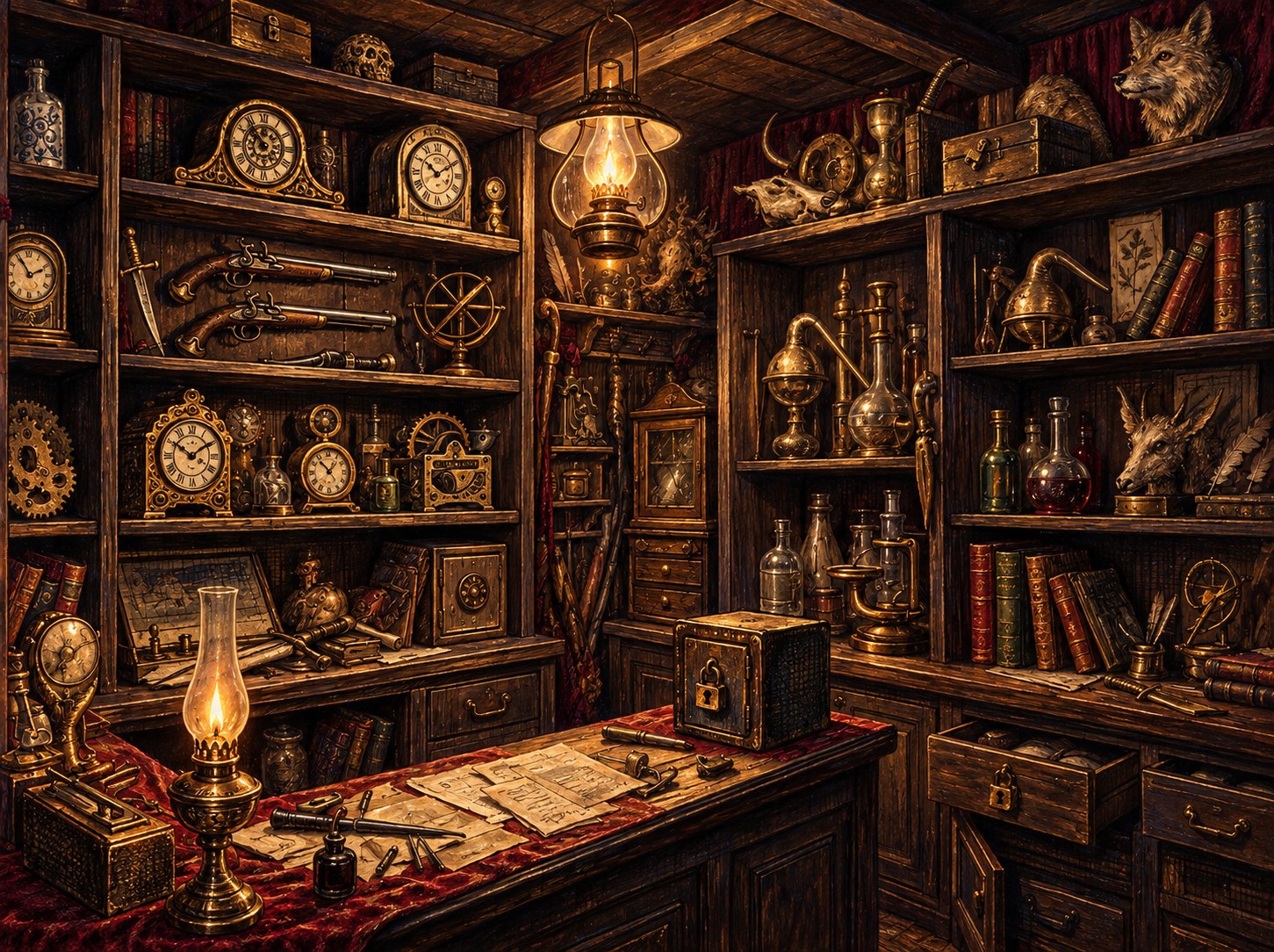
OLIVIA'S JOURNAL: INVESTIGATIONS IN KORMOR KIRAK
A Supplement for The Eternal Court TTRPG
CASE 1: THE MISSING SEAMSTRESS
Olivia's Account
The request came through Tomas the Stablehand, naturally. A young seamstress named Magrit Soller hadn't been to her shop in Kereskedo Marketplace for three days. Her landlady was worried. Her friends were worried. I was skeptical -- people disappear in Kormor Kirak with regularity, and most of them are deliberate about it.
But the details nagged at me. Magrit didn't have enemies. She kept to herself, did fine work, paid her rent. The landlady reported that Magrit had been working on "something special" before she vanished -- not the usual mundane garments, but something elaborate. Silk lining. Hand-stitched panels. The kind of work that takes weeks.
I started with the obvious. Magrit's shop was empty, undisturbed. No signs of struggle. The landlady let me see her room -- neat, modest, utterly unremarkable. But on the work table sat three unfinished pieces, all elaborate cloaks. The thread work was immaculate, almost obsessive in its precision. And the design -- a pattern I'd seen before, months ago. On a Red Guard captain's ceremonial coat.
That's when things got complicated.
I visited Rozito Vallikozo. The man's a fixer; if someone wanted a seamstress for something off the ledgers, Rozito would know. He was cagey at first, but I have a way of making conversation persuasive. Magrit had indeed been approached -- not by him, but the job came through his network. Someone wanted three cloaks made, the design already specified, payment generous, and discretion absolute.
"Where's the seamstress?" I asked.
"Safe," Rozito said. "Paid better than she'd make in a year. Doing work for someone very important."
"Kiraline?"
He didn't answer, which was answer enough.
I had a choice then. Report it to Barron Whitehallow and risk the resistance's limited resources on a single girl? Investigate further and potentially walk into something far larger? Or let it go and sleep well for one more night?
I chose the third option. I reported a false lead to Tomas -- merchants, I said, likely transported her across the river for work elsewhere. He seemed satisfied. I have no doubt Magrit is alive, making clothes for someone in the Red Guard or worse. Some people you can't save without burning down what you've built.
That bothers me more than I'd like to admit.
The Setup
Magrit Soller, a talented seamstress of modest means, has vanished from her shop. The characters may be hired by her landlady, concerned friends, or representatives of the resistance seeking to understand if the disappearance connects to resistance activities. What begins as a missing person case quickly reveals patterns of coercion and forced labor within Kormor Kirak.
The truth is layered: Magrit was approached through intermediaries (Rozito) with an offer to do specialized tailoring work. The job is legitimate, if troubling -- she's being tasked with creating elaborate ceremonial garments for the Red Guard's upper command. She's been moved to a secure location (a guarded compound near the castle) and is being well-compensated, but she cannot leave. She didn't realize this when she accepted; by the time she understood the situation's true nature, she was already inside the castle's orbit.
Key NPCs Involved
Magrit Soller -- A talented seamstress, mid-30s, quiet and skilled. She didn't understand the implications of her work until it was too late. She's currently being treated well but is under guard. She's frightened, desperate to communicate with her landlady, but has been told that any contact would endanger the people she cares about.
Rozito Vallikozo -- The fixer who brokered the arrangement. He genuinely doesn't see the harm; he facilitates connections, nothing more. If pressed, he'll admit he knows who hired Magrit, but revealing that information is bad for business, and more importantly, bad for his health.
Captain Dmitri Voss -- A Red Guard officer who specifically requested Magrit's services. He's preparing for some ceremonial event and wants garments of exceptional quality. He's not actively cruel, but he's casual about the means used to achieve his ends.
Magrit's Landlady -- A worried older woman named Constance Veyer. She's genuinely fond of Magrit and legitimately concerned. She's the characters' most likely initial contact.
The Guard Detail -- Two Red Guard soldiers assigned to watch Magrit. They're professional but not sadistic. They won't volunteer information, but they can be negotiated with, bribed, or evaded.
Locations
Magrit's Tailor Shop (Kereskedo Marketplace) -- A modest storefront with living quarters upstairs. The shop is neat and organized. The three unfinished cloaks are displayed on a workstation. Thread, needles, fabric scraps. Nothing explicitly threatening, but the quality of the work is notable. Searching the space thoroughly reveals a note hidden in a sewing box: a single word in Magrit's handwriting: "trapped."
Constance's Boarding House -- An older building housing various working-class residents. Constance lives on the ground floor and can provide descriptions of Magrit's visitors, though her recollections are incomplete. She remembers a well-dressed man (Rozito) and money being exchanged.
Rozito's Establishment -- A seemingly legitimate business front. Comfortable, neutral ground where deals are brokered. Rozito won't be hostile unless provoked, and even then, he'll opt for evasion over confrontation. The space reveals little of direct value, but Rozito himself is a wealth of information if the characters can convince him to share.
The Red Guard Compound (near Castle Torony Piros) -- A heavily fortified location where Magrit is currently being held. It's not a dungeon; she's in a comfortable workshop with guards stationed outside. Breaking her out requires either stealth, bribery, or a direct confrontation with the Red Guard.
Possible Complications
- The Resistance Complication -- If the characters are resistance-aligned, Barron Whitehallow wants to extract Magrit quietly. This creates urgency but also constraints; a frontal assault is politically untenable. Whitehallow is more interested in learning why the Queen's forces suddenly need ceremonial garments -- what event is being planned?
- The Ambition Angle -- Captain Dmitri Voss is actually competing with other officers for a promotion. Kiraline is selecting a new commander for her personal guard, and Voss believes that appearing with perfect ceremonial dress and a fully realized vision will impress her. He doesn't know Magrit is being coerced; he paid Rozito, and Rozito handled the details. If the characters explain the situation, Voss might be appalled -- or he might not care.
- The Lich Cult Connection -- One of the characters' informants mentions that the Lich Cult has been recruiting heavily from Kormor Kirak's working poor. Magrit's disappearance might be unrelated, but the timing is suspicious. Perhaps Magrit was approached by cult members, or perhaps the cult is investigating the same forced-labor networks for their own purposes.
- The Escalation -- If the characters make too much noise investigating, Lady Mireva (Kiraline's spy network) becomes aware of their interest. She assigns agents to determine whether this is a resistance operation or simple curiosity. This elevates the threat level significantly.
- Magrit's Reluctance -- When the characters finally locate Magrit, she might refuse extraction. She's been promised enough money to leave Kormor Kirak entirely. She's trapped, but she's also being treated well and can see a light at the end of the tunnel. Forcing her to come with them against her will creates moral ambiguity.
Resolution Options
Resolution 1: The Negotiation -- The characters approach Rozito with an offer to buy out Magrit's contract. This costs money (significant but not prohibitive), and Rozito will broker the deal on one condition: the characters never ask him about it again, and they understand that other arrangements like this happen in Kormor Kirak regularly. Magrit is released unharmed, and the characters gain a valuable intermediary contact.
Resolution 2: The Heist -- Using infiltration, bribery, or misdirection, the characters break Magrit out of the compound. This is more dangerous; it requires careful planning and carries the risk of direct conflict with Red Guard soldiers. If successful, Magrit is extracted but becomes a fugitive, and the Red Guard will investigate the breach.
Resolution 3: The Leverage -- The characters identify Captain Dmitri Voss's ambitions and threaten to expose his use of coerced labor to Kiraline or to other officers competing for the same promotion. Voss, wanting to distance himself from a potential scandal, arranges for Magrit's release and fires the intermediaries he used.
Resolution 4: The Quiet End -- The characters accept that Magrit cannot be saved without serious risk. They provide her with a method to contact the outside world (a message hidden in a delivered package) and information about where she can go when her contract is complete. It's not a rescue, but it's a small kindness.
Resolution 5: The Cult Discovery -- During their investigation, the characters uncover evidence that members of the Lich Cult were planning to approach Magrit specifically, believing her work on ceremonial items for the Red Guard might give her access to intelligence. The characters can warn Magrit of this danger, which shifts her perspective on her situation.
Connections to the Larger Conspiracy
This case is a microcosm of Kormor Kirak's oppression. It reveals how the Queen's apparatus operates through intermediaries and coercion. More specifically:
- The ceremonial garments are being prepared for a significant state event -- possibly the Comet Chamber dedication or a major Red Guard ceremony related to it.
- The fact that Magrit is restricted rather than willing raises questions: Why does Kiraline need secrecy around her military preparations?
- If the Lich Cult is involved, it suggests they're actively infiltrating the Queen's networks, which is a major development.
- Rozito's casual acceptance of the arrangement reveals how normalized exploitation is in the city. Change will be slow and difficult.
CASE 2: THE CLOCKMAKER'S CONFESSION
Olivia's Account
Brother Aldric brought me a confession, which is to say he brought me a problem wearing a confession's clothing.
The clockmaker was local -- Karl Hemmer, operated a small shop near Cliff Road. According to Aldric, Karl came to the monastery three days ago in a state of considerable distress. He claimed to have been working on a commissioned piece for a decade. A clock. Not just any clock -- an astronomical clock, designed with precision that Karl insists was "beyond natural geometry." The commission came from an intermediary who paid extraordinary sums and was entirely clear that the work must be accurate to specifications that seemed, frankly, impossible.
Karl had been using his own knowledge, supplemented with texts he acquired from Devorlen Koss's curiosity shop. Texts on mathematics, on celestial mechanics, on things that don't have names in languages still spoken.
Three days ago, Karl finished the work. The moment the last component was fitted and the clock began to turn, he suffered a clarity -- his word, not mine. He saw, he claimed, what the clock was actually for. Not timekeeping. A door. A mechanism calibrated to align with something coming. Something astronomical.
Karl came to Aldric in genuine terror, believing he'd committed some profound sin. He wanted the clock destroyed. He wanted forgiveness he probably doesn't deserve and almost certainly won't get.
I listened to Aldric's account with what I hope was professional detachment and felt, for the first time in months, the kind of cold that comes from understanding how deep this goes.
A clock aligned with the coming comet. A clock designed by someone brilliant enough to achieve impossible precision. And now -- I had to assume -- someone would come to collect it.
"Where is Karl now?" I asked.
"Still at the monastery," Aldric said. "Praying. I don't think he's slept."
"And the clock?"
"Hidden. I took the liberty."
Good man, Aldric.
I spent the next four days doing what I do best -- asking quiet questions in the spaces between other conversations. Devorlen Koss had indeed sold astronomical texts recently. The purchaser paid cash, never asked questions, seemed to know exactly what they were looking for. Jack Winbow's smuggling network had moved several shipments of astronomical instruments through Kormor Kirak in the last six months. The Marketplace Butcher mentioned that a well-dressed woman (likely Lady Mireva) had been asking about craftspeople in the city -- specifically asking for those with "precise hands and open minds."
The Queen is building her Comet Chamber. Of course she's building precision instruments to align with it. Of course she's found someone brilliant enough to create them, whether willingly or under duress.
And Karl Hemmer, poor bastard, had just handed her a key.
I visited him at the monastery. He was gaunt, hollow-eyed, functioning on prayer and guilt. I asked him a simple question: "Did they approach you initially, or did the commission come through channels that seemed legitimate?"
"Legitimate channels," he whispered. "It seemed like a patron. A wealthy patron. They never threatened anything. They just... asked for precision. Perfect, inhuman precision. And I achieved it."
"Karl," I said, "that clock is now a liability. Not because you created it, but because someone will kill to obtain it. Possibly someone will kill you."
He looked at me with eyes that had already surrendered.
"What would you have me do?"
That's the question that keeps me awake, isn't it?
The Setup
A local clockmaker has commissioned a piece with extraordinary specifications that he came to believe has sinister purpose. The clock is designed with astronomical precision aligned to the comet's trajectory. The characters may become involved through Brother Aldric, through the clockmaker himself, or through their investigations into Queen's activities. The central mystery: who commissioned this work, and what is it actually for?
The truth is that the Comet Chamber project requires multiple precision instruments calibrated to the comet's position and trajectory. The Queen's occultists have designed these instruments, but their realization requires mundane craftsmanship of supernatural accuracy. Karl was identified as someone capable of achieving this precision. He wasn't coerced initially -- the commission came through what appeared to be legitimate patronage channels. Only as he approached completion did he begin to suspect the true purpose.
Now, multiple factions are aware of or suspect the clock's existence: the Queen's agents (who will want to retrieve it), the Lich Cult (who want to study it or disrupt it), and potentially the resistance (who want to understand what the Queen is building).
Key NPCs Involved
Karl Hemmer -- A masterful clockmaker in his early 50s, meticulous to the point of obsession. He's a good man who's terrified he's participated in something monstrous. He's NOT a leader and will defer to the characters, but his technical knowledge is invaluable. He's also extremely fragile psychologically; poor treatment or pressure might break him entirely.
Brother Aldric -- A monk of genuine faith and genuine compassion. He's hiding Karl as an act of mercy and principle, not as a political statement. He can provide safe harbor temporarily, but he can't protect Karl indefinitely. Aldric is a solid ally but has clear limitations.
The Mysterious Patron -- The person who originally commissioned the clock. They likely work for the Queen directly or for the Lich Cult. They haven't revealed their face or name; all communication was through intermediaries. They paid in advance and seemed entirely unconcerned with Karl's emotional state or reliability.
Devorlen Koss -- The curiosity shop owner provided the texts Karl used. Koss is pragmatic and amoral; he sells knowledge to anyone with coin. He won't proactively help, but he can be questioned about the purchaser's identity.
Jack Winbow -- The smuggler moved astronomical instruments through the city. If the characters ask the right questions, he can confirm this and might provide descriptions of the buyers or delivery locations.
Lady Mireva -- The Queen's spy network director who specifically recruited craftspeople for unknown purposes. She's a distant antagonist in this case but represents the Queen's active interest in Kormor Kirak's artisans.
Locations
Karl's Clock Shop (Cliff Road) -- A modest storefront with a workshop in the back. It's currently unoccupied, as Karl has been at the monastery. The shop contains various clocks in different states of completion, tools of supernatural precision, and numerous reference texts. Searching it reveals bills of sale, payment receipts in cash, and designs for the astronomical clock -- if the characters know what they're looking for, they can find technical specifications that confirm the comet alignment.
The Monastery (exterior to the city) -- A peaceful sanctuary where Karl is currently hiding. Brother Aldric maintains the space. It's safe but cannot serve as a long-term refuge; monks maintain the monastery's neutrality carefully, and harboring a fugitive eventually becomes untenable.
Devorlen Koss's Curiosities (Kereskedo Marketplace area) -- A cluttered shop filled with unusual items. Koss himself is more forthcoming than usual in a neutral setting, though he won't betray customers. He might provide general information about the texts sold ("astronomical," "mathematical," "concerning celestial bodies") without naming the purchaser.
Jack Winbow's Hideout -- An undisclosed location known only to trusted contacts. Winbow can be reached through intermediaries or by reputation. He's pragmatic; if the characters offer payment or future favors, he might confirm his knowledge of the instruments and provide descriptions.
The Clock's Hidden Location -- Brother Aldric has hidden the clock in the monastery. It's a masterwork, beautiful and terrible, ticking with an accuracy that seems almost unnatural. Being near it produces a subtle discomfort in those sensitive to such things.
Possible Complications
- The Lich Cult's Interest -- Cult agents are also looking for the clock. They want to study it, disable it, or corrupt it. If the characters are followed to the monastery, they might have to defend it against cultist infiltrators.
- The Queen's Agents -- Lady Mireva's operatives become aware of Karl's disappearance and begin canvassing the city. They're not openly hostile but are thorough. They'll eventually lead the characters' location if they're not careful.
- Karl's Deterioration -- The more time Karl spends hiding, the more his mental state degrades. He oscillates between guilty fervor and suicidal despair. If he's mistreated or pressured, he might choose to end his life rather than continue. If he's treated with kindness, he becomes dependent on that kindness and struggles when he must be moved or separated from it.
- The Moral Question -- What do the characters do with the clock? If they destroy it, they disrupt the Queen's plans but also destroy a masterwork and eliminate evidence. If they keep it, they become targets. If they try to modify it, they might accidentally trigger something.
- The Comet's Approach -- Time is not neutral in this case. As the comet approaches, the clock's significance increases. The Queen's urgency increases. Everyone's timeline accelerates.
- Devorlen Koss's Betrayal -- If the characters press Koss too hard or make their interest obvious, he might sell information to the highest bidder. He's amoral; the Queen's gold is as good as anyone's.
Resolution Options
Resolution 1: Destruction -- The characters convince Karl or simply decide themselves that the clock must be destroyed. This satisfies their moral concerns but infuriates the Queen and eliminates their ability to understand what the clock does. Destroying it might also trigger supernatural consequences if it's truly aligned to the comet.
Resolution 2: Relocation -- Using Jack Winbow's network or the resistance's resources, the characters arrange for Karl and the clock to be smuggled out of Kormor Kirak. This preserves both but requires significant resources and creates a loose end -- Karl will likely find his way back to his craft elsewhere, and the clock might resurface in another context.
Resolution 3: Infiltration -- The characters study the clock, understand its mechanisms, and create a modified version that appears authentic but is subtly corrupted. They present this false clock to be collected, while keeping the real one hidden. This requires technical expertise and carries high risk of discovery.
Resolution 4: Leverage -- The characters use knowledge of the clock's existence to bargain with the Queen's agents or with the Lich Cult. They offer the clock in exchange for something valuable -- information, protection, resources.
Resolution 5: Sacrifice -- The characters convince Karl to turn the clock over to the Queen voluntarily, positioning him as someone who had doubts but has now seen the necessity of the Queen's plans. This protects Karl from being hunted but involves a moral compromise and might create resentment among the characters' allies.
Resolution 6: The Cult Route -- The characters approach the Lich Cult and offer them the clock's location in exchange for aid against the Queen. This creates a three-way complication where the Cult, the Queen, and potentially the resistance are all pursuing the same object.
Connections to the Larger Conspiracy
This case directly illuminates the Comet Chamber project. The clock is one of several precision instruments being constructed to align with and harness the comet's power. The case reveals:
- The Queen is actively recruiting Kormor Kirak's finest craftspeople through intermediaries and patronage.
- Supernatural precision is required for her plans -- ordinary craftsmanship won't suffice.
- The clock's alignment suggests that the comet's arrival will occur on a calculable date, and the Queen has methods to predict and prepare for it.
- The Lich Cult is aware of the project and is working to either support it, subvert it, or harness it for their own purposes.
- Characters who study the clock can gather significant intelligence about the Queen's timeline and the nature of the instrument.
CASE 3: THE VANISHING GUESTS
Olivia's Account
Eppy Flinder is a gossip, which makes her useful, and a listener, which makes her trustworthy. She's also one of my few real friends in this godforsaken city, which means I listen when she comes to me with genuine fear in her eyes.
Four guests at her pub had simply vanished. Not escaped, not obviously murdered, not even arrested by the Red Guard. They'd been there one evening, social, drinks in hand, making normal conversation. The next morning, their rooms upstairs were empty. No signs of disturbance. Their belongings left behind. They were gone the way people are gone when they never existed to begin with.
"They weren't Kormor Kirak," Eppy said. "You could tell immediately. They had Albion accents, wore Albion clothes. One of them -- the woman -- she said she was an ambassador's aide."
I felt something cold settle in my chest.
"Did anyone from the Red Guard come to collect them?"
"No one official," Eppy said. "But there was a woman. Well-dressed, kept to the shadows, watched them for an entire evening. She left around midnight. The next morning, I went to wake them -- they hadn't checked out -- and they were gone. All four. Like smoke."
Albion representatives vanishing in Kormor Kirak isn't necessarily a disaster. But it's definitely a problem. Ambassador Harken was already navigating political tightropes; this could blow them all up.
I met with Harken under the pretext of selling him intelligence (which I was; transparency in our transactions keeps the relationship valuable to both of us). I told him about the missing people without mentioning how I knew.
His reaction confirmed my fears. "Those are diplomatic observers," he said quietly. "They were meant to be temporary, eyes-and-ears for the Crown. If they're missing..." He trailed off, understanding the implications without needing them explained. If Albion Crown's observers are being disappeared by the Queen, the situation has escalated significantly.
I investigated further. The woman Eppy described matched a pattern I'd noticed before -- someone working for Lady Mireva, almost certainly. The woman had been methodical: she'd observed the targets, identified their location, and then acted with precision. The targets were removed, but not violently. No bodies, no blood, nothing at the pub to suggest foul play.
That suggested capture, not assassination.
I made inquiries about holding locations, about places where the Red Guard might keep foreign prisoners quietly. The Marketplace Butcher mentioned rumors of activity at the castle dungeons, but also something else: movement of prisoners to "elsewhere," somewhere in the city where the Queen keeps her more special guests.
That's when things got stranger.
I received a message -- no source, just a note -- with a location and a single word: "Comet."
It was Jack Winbow's handwriting.
I met him in an alley he'd specified. Jack is many things, but a hero isn't one of them. He sells information, loyalties, and services to whoever pays. So when he approached me with information about missing persons, I was immediately suspicious about his motivation.
"The Albion people," he said. "They're being held somewhere. The Queen wants something from them -- intelligence about Albion's movements, their military preparations, something. The woman you're asking about works for someone in the castle directly. Not Lady Mireva. Someone else."
"Who?"
"Don't know for certain. But there's been talk about a new office in the castle, something to do with astronomical observations. Your Albion observers knew something about Albion's military astronomy program. The Queen wanted them quiet and available."
That was enough.
I never did determine exactly where those four were being held. I passed the information to Harken, and diplomatic channels began to move in ways I'll never fully understand. The situation was eventually... resolved, though I suspect the resolution involved compromises neither side felt entirely good about.
But that's how it works in Kormor Kirak. You save some people. Some people you can only try to minimize the damage for. And some people you never know whether they lived or died.
The Setup
Four diplomatic observers from Albion have vanished from a local pub under mysterious circumstances. Their disappearance could create an international incident if not handled carefully. The characters may be approached by Ambassador Harken, by Eppy Flinder, or by other contacts concerned about the political implications. This case combines missing persons investigation with political intrigue and reveals the extent to which the Queen is willing to bend international relations toward her goals.
The truth is that the four observers were indeed removed by Lady Mireva's agents. The Queen has learned that Albion has been studying the comet's trajectory and its potential for astronomical manipulation. The observers were in Kormor Kirak to gather intelligence on the Queen's activities and to determine whether she poses a threat to Albion's interests. The Queen, rather than creating an international incident by executing them, has chosen to capture them and extract what intelligence they possess. They're being held in a secure location within or near the castle, under watch but treated well enough that they remain cooperative.
Key NPCs Involved
Eppy Flinder -- The pub owner, a woman in her 50s with sharp eyes and sharper ears. She's genuinely distressed about the disappearances and concerned about what they might mean for her business and her city. She's a reliable witness and a good person to have on the characters' side.
Ambassador Harken -- The Albion diplomat, formally polite but clearly stressed by the situation. He walks a careful line between protecting his agents and avoiding actions that could trigger full conflict with Kormor Kirak. He's manipulative but not villainous; he genuinely believes he's doing what's best for Albion.
The Four Observers -- Sarah Westbrook (aide, mid-20s, highly trained in observation), Thomas Mercer (military advisor, 40s, professional soldier), Helena Croft (astronomer, 30s, specifically recruited to analyze the Queen's activities), and David Lyons (junior diplomat, 20s, mostly present for training). They're competent but are now captives in a situation they didn't fully anticipate. They're not being tortured, but their situation is dire.
Lady Mireva -- The Queen's spymaster who orchestrated the capture. She appears only peripherally in this case but represents the Queen's willingness to escalate.
The Woman in the Shadows -- The agent who conducted the observation and extraction. She's professional, efficient, and entirely willing to use violence if necessary. She reports to Lady Mireva.
Jack Winbow -- The smuggler who has intelligence on the situation. His motivation for sharing information is complex; he might want leverage against the Queen, might be playing multiple sides, or might have been told to feed this information to the characters as part of a larger game.
Locations
Eppy's Pub -- A popular establishment in the city where locals and travelers mix. The upstairs contains rooms for guests. The room where the four observers stayed is modest and gives little away; they were careful not to leave obvious intelligence.
The Embassy -- Albion's diplomatic headquarters, a secure building where Harken coordinates with Albion Crown. The characters might visit here to meet Harken or to gather additional context.
Suspected Holding Locations -- The castle dungeons are an obvious guess, but the Queen likely wouldn't keep diplomatic prisoners there. More likely locations include:
- A secure manor house on Cliff Road, currently commandeered for the purpose
- A tower within the castle's lower structures, used for special prisoners
- A hidden location outside the city but within the Queen's control
The Alley Meeting Point -- Where Jack Winbow delivers information to the characters. It's anonymous, easily abandoned, exactly the kind of place where compromising meetings happen.
Lady Mireva's Operations Center -- The characters might not find this location easily, but it's where the decision to capture the observers was made and where their interrogation is being directed. It exists somewhere in or near the castle.
Possible Complications
- The International Incident Risk -- Any obvious action by the characters to rescue the observers could cause Ambassador Harken to panic. He might demand they back off, creating conflict between their desire to help and political realities. Alternatively, Harken might decide the risk is worth it and commit Albion resources, escalating the threat level dramatically.
- Jack Winbow's Game -- Winbow might have his own agenda. He could be selling the information to the characters while simultaneously selling it to the Queen. He could be angling for a reward from Harken or setting the characters up for a trap. Determining his true motivation requires interaction and judgment.
- The Lich Cult's Interest -- The cult has learned about the Albion observers and their astronomical knowledge. They want access to those observers to extract information about alternative methods of harnessing the comet. This could mean the characters have a three-way situation with the cult also pursuing the observers.
- Captain Ashford's Involvement -- Captain Ashford is the senior Albion military liaison in Kormor Kirak. He's more hawkish than Ambassador Harken and might advocate for rescue by force. This creates division among potential allies.
- The Interrogation Timeline -- The longer the observers are held, the more information they'll divulge. The characters need to act relatively quickly, but too quick an action risks visible failure. There's urgency without total clarity about how to proceed.
- The Observer's Knowledge -- One of the observers (Helena Croft, the astronomer) actually knows significant information about the comet's properties that would be invaluable to the Queen's plans. The Queen will extract this, and the observer might not survive the extraction intact.
- The Diplomatic Trap -- The Queen could deliberately ensure that the observers' disappearance becomes known, baiting Albion into a response that justifies further escalation on the Queen's part. In this scenario, the whole situation is a setup.
Resolution Options
Resolution 1: Direct Negotiation -- The characters work with Ambassador Harken to approach the Queen's representatives directly. They negotiate for the observers' release in exchange for Albion's agreement to cease astronomical research or to share its findings with Kormor Kirak. This resolves the situation diplomatically but leaves the observers' fates uncertain and might require agreeing to unfavorable terms.
Resolution 2: The Rescue -- Using intelligence gathered through investigation, the characters attempt to locate and extract the observers. This might be a heist, a commando raid, or a complicated series of steps involving bribery and deception. Success frees the observers but creates an active conflict with the Queen's forces and has long-term diplomatic consequences.
Resolution 3: The Exchange -- The characters arrange for something the Queen wants (or thinks she wants) in exchange for the observers. This might involve the astronomical clock from Case 2, information about Albion's capabilities, or something else valuable. The exchange could be legitimate or a setup for betrayal.
Resolution 4: The Escape Facilitation -- Rather than a direct rescue, the characters provide the observers with tools, disguises, and routes to escape on their own. This is slower but reduces the characters' direct involvement and relies on the observers' own competence.
Resolution 5: The Cult Alliance -- The characters approach the Lich Cult with information about the observers' location, proposing a joint operation. The cult infiltrates the holding location, creates chaos, and the characters use that chaos to extract the observers. This is risky but might be the only viable path given the numbers involved.
Resolution 6: The Sacrifice -- The characters negotiate for the release of some observers while accepting that others will remain or might have been executed. This is morally difficult but politically realistic.
Resolution 7: The False Intelligence -- The characters learn what intelligence the Queen is seeking and feed her false or corrupted information through the observers. This might convince the Queen to release them early or allow the characters access to them.
Connections to the Larger Conspiracy
This case reveals the Queen's deep interest in astronomical knowledge and her willingness to involve herself in international politics to acquire it. Specifically:
- The Queen is aware that Albion possesses knowledge about the comet that she wants. This suggests potential future conflict with Albion.
- The observers' capture confirms that the Queen's plans are reaching a critical stage; she needs specific knowledge to proceed.
- The precision with which the capture was executed shows that Lady Mireva's network is effective and dangerous.
- If the characters rescue the observers, Albion becomes invested in what happens next in Kormor Kirak, potentially shifting the balance of power.
- The observers' astronomical knowledge, if shared, could provide the characters with crucial information about the Comet Chamber's purpose and timeline.
CASE 4: THE BONE COLLECTOR
Olivia's Account
The message came to me in the form of a severed finger left in my room.
I didn't panic, which is the kind of statement that reveals how much I've changed since arriving in this city. Instead, I examined it carefully. It was small, delicate, from someone young. There was a note, written in childish letters pressed hard enough to leave indentations: "COME TO HALLASET FIELDS. COME ALONE. KNOW WHAT KIRALINE TAKES."
Hallaset Fields is the cemetery to the north, a sprawling burial ground for Kormor Kirak's common dead. I've avoided it thus far, and not without reason. There's something wrong with that place -- the air tastes of copper and old grief, and the graves are too numerous for a city of this size. The dead are closer together than they should be.
I went, of course. Alone, armed, and with considerable annoyance.
The woman I found at the cemetery's heart was young, probably mid-20s, wearing clothes so filthy they'd achieved a texture of their own. Her eyes were bright with an intelligence that contrasted sharply with her physical degradation.
"My name is Petra," she said. "I was taken by the Queen's people three years ago. I was eleven. I worked in the castle kitchens. There are others like me -- children, mostly, some adults. We're not fed. We're... used differently."
"Used for what?" I asked, though I suspected I knew.
"Bone," Petra said simply. "The Queen takes bones. Ribs, fingers, vertebrae, skulls. Not all at once -- she's not that wasteful. But over time. They take them and we keep living. Or mostly we do. Some don't. Some die from the absence, from infection, from despair."
I felt something crystallize in my chest. I'd heard rumors about bones, about the castle's strange medical practices, about what the Queen might be building. But rumors are just noise. This was evidence, and this was rage.
"There's a doctor," Petra continued. "In the castle. He performs the removals. He uses magic -- something to numb the pain, something to make the wounds close wrong, something to make sure we stay alive to donate again. He's proud of his work. He talks about the precision of it."
"How many?" I asked.
"Forty-three that I'm certain of. Maybe more. The Queen doesn't let us see each other, but we listen through the walls. Forty-three people being harvested like crops."
I sat down on a gravestone and contemplated just how far I was from home and how much I was willing to do to address what I'd just learned.
Petra escaped a month ago, hiding in the cemetery because it was the one place the Queen's people seemed reluctant to search thoroughly. She's been surviving on scraps, on sympathy from groundskeepers, on pure desperation. She wants her bones back -- she can feel their absence like phantom limbs, and she wants the other prisoners freed.
I investigated further and discovered that the bone removals are indeed real. The Queen is constructing something -- not yet fully clear what -- and it requires bone. Specifically, it requires many bones, intact and whole but separated from their original owners. The magic involved is complex and deeply unpleasant; I found references in Devorlen Koss's shop to necromantic theory involving bone as substrate, bone as foundation, bone as vessel.
The doctor doing the work is someone named Volkmar, a figure I've heard whispered about in the city. He's not Kormor Kirak born; he's from the east, brought to serve the Queen specifically for this purpose. He's technically brilliant and morally bankrupt in exactly the way required for this work.
My investigation led me to a dead end, which is to say, to a decision point.
I could have brought this to Barron Whitehallow. The resistance would be very interested in a bone-harvesting program in the castle. They'd want to shut it down, to rescue the prisoners. But shutting it down would require direct action in the castle itself, and I don't have confidence the resistance could execute that without massive casualties.
I could have approached Ambassador Harken with it, presenting it as a human rights violation that might sway Albion's diplomatic position. But Harken is pragmatic, and the bone harvesting isn't officially acknowledged. He would likely respond by doing nothing, which accomplishes exactly nothing.
I could have contacted Jack Winbow and asked him to smuggle the prisoners out. He might have done it, for a price, but the price would be steep, and the Queen would almost certainly track them down afterward.
Instead, I did what I always do when I'm confronted with something too large to move: I documented it carefully. I gathered evidence. I mapped what I could learn about the bone collection process, the prisoners' locations, the doctor's movements. And I filed it all away in the back of my mind as something to be addressed when I had more resources, or more allies, or simply more information.
Petra, though. Petra I tried to help.
I established a safe channel for her to contact me. I provided her with resources to survive more comfortably in the cemetery. And I promised her -- knowing it was a promise I might not be able to keep -- that the bone harvesting would stop. Someday.
It's a poor promise, but it's all I had to offer.
The Setup
The characters encounter evidence of a systematic program of bone harvesting conducted by the Queen for an unknown purpose. This might come through a direct encounter with Petra (a survivor), through investigation of missing persons, or through discovery of Volkmar's work. This case is fundamentally about injustice on a scale that forces moral reckoning: the characters will likely not be able to completely stop the program, but they can choose how much they're willing to risk to prevent new victims or rescue existing ones.
The bone harvesting is real and ongoing. The Queen's magical plans for the Comet Chamber apparently require a particular substance that can be crafted from bone, either as a material component or as something more mystical. Volkmar has been tasked with collecting a specific quantity (the current total is 43 prisoners; the Queen wants 100). The prisoners are kept alive through magical means in a secure location within the castle's lower levels. The program is secret but not so secret that rumors don't circulate in the city's underworld.
Key NPCs Involved
Petra -- A survivor of the bone harvesting program, mid-20s mentally but emotionally fractured. She's intelligent and observant but is also traumatized and prone to emotional volatility. She's the most reliable witness to the program's mechanics, but her reliability is compromised by her own psychological state. She wants to help free the other prisoners but is also terrified of the castle and its agents.
Volkmar -- The doctor conducting the bone removals. He's brilliant, meticulous, and entirely convinced that he's contributing to something magnificent. He's not sadistic in a crude way; he simply doesn't think of his subjects as fully human. He's protected by the Queen's favor and is well-armed and trained in magic.
The Queen -- Kiraline appears only peripherally in this case, but it's her program, her decision, her magical needs driving the whole horrible system.
Mercy/The Prison Guard -- A female Red Guard captain assigned to oversee the bone-harvesting facility. She's professional and isn't cruel, but she's thorough. Her name is Captain Mercy Falke, and she has a slight gambling problem that might be exploitable.
The Other Prisoners -- 43 living people (or 42, if one has died since Petra's escape) in various states of physical and psychological degradation. They're not unified in their desires; some have given up, some are plotting escape, some have made peace with their situation through denial.
Brother Aldric -- The monk might become aware of the bone harvesting through confessions or rumors. He would be horrified and might offer the monastery as a sanctuary for escaped prisoners, at significant risk to himself.
Locations
Hallaset Fields Cemetery -- The sprawling burial ground where Petra hides and where the characters might initially encounter her. The cemetery is large and provides cover but is also watched by the Queen's agents.
The Castle's Lower Levels -- The bone-harvesting facility is located in a secure section of the castle's dungeons, in an area not typically accessed by regular guards. It's heavily warded with magical protections and has limited access points.
Volkmar's Private Quarters -- Somewhere in the castle, Volkmar maintains a personal workshop where he studies the bone material and works on preparing the collected bones for their eventual use. This space contains his research, notes, and possibly samples of the processed bone.
The Prison Cells -- Separate chambers within the harvesting facility, each holding 2-4 prisoners in varying states of health. The cells are maintained with magical wards that prevent escape and allow the guards to monitor the prisoners remotely.
The Medical Facility -- Where Volkmar performs the bone removals. It's equipped with surgical tools, magical apparatus, and containment systems designed to keep the prisoners alive despite the procedures.
Possible Complications
- The Scale of the Problem -- There are 43 prisoners. The characters cannot save all of them without major resources and planning. Attempts to rescue everyone will likely result in catastrophic failure. This forces uncomfortable choices about who to save first, who must be left behind, and whether partial rescue is acceptable.
- The Magical Wardings -- The harvesting facility is protected by complex magical locks and alerts. Breaking in openly triggers immediate response from the Red Guard. Bypassing the wards requires either magical expertise or a very detailed knowledge of the system.
- Volkmar's Competence -- Volkmar is not a pushover. He's a trained mage with defensive spells, the backing of the Queen's authority, and personal guards. Confronting him directly is extremely dangerous.
- The Prisoners' Condition -- Many of the prisoners are physically and psychologically broken. Even if rescued, they won't be able to move quickly or independently. Care for escaped prisoners becomes an immediate logistical problem.
- Captain Mercy Falke's Complications -- While Mercy isn't cruel, she's doing her job. She won't be bribed into simply opening the doors, but she might be manipulated, tricked, or blackmailed. Her gambling debts could be exploited, or her family could be threatened.
- The Queen's Escalation -- If the characters become known as threats to the bone-harvesting program, the Queen will escalate her interest in them. She might task Lady Mireva with eliminating them, or she might increase security at the facility, making future rescue attempts even more difficult.
- Petra's Emotional State -- Petra is not a reliable ally. She might attempt something reckless without the characters' approval, or she might break down at crucial moments. She could also become a liability if she's recognized inside the castle.
- The Lich Cult's Knowledge -- The Lich Cult is aware of the bone harvesting, at least in general terms. They might try to disrupt the program themselves to deny the Queen resources, or they might try to steal the processed bones for their own purposes.
- The Moral Question of Magic -- If the characters capture Volkmar, they must decide his fate. Executing him is justice but also murder. Turning him over to justice requires institutional support they might not have. He's valuable alive (he has knowledge about the Queen's plans) but also horrifically dangerous.
Resolution Options
Resolution 1: The Partial Rescue -- The characters plan and execute a careful infiltration aimed at liberating a small group of prisoners (8-12 individuals). This requires detailed planning, magical or infiltration expertise, and careful exit strategy. Success saves some lives but leaves the majority of prisoners in the castle and likely triggers escalation in the bone-harvesting program (the Queen will intensify collection to meet her quotas).
Resolution 2: The Sabotage -- The characters don't rescue prisoners but instead sabotage the harvesting facility. They poison Volkmar's magical apparatus, corrupt his research, or destabilize the wardings. This disrupts the program temporarily but doesn't save any current prisoners and allows the Queen to assign a new doctor and rebuild the system.
Resolution 3: The Exposure -- The characters leak information about the bone harvesting to Ambassador Harken, the resistance, and the city's population. This makes the program untenable to continue openly, but the Queen's response is unpredictable. She might intensify security and accelerate the bone collection, or she might move the program elsewhere. The political pressure doesn't immediately save anyone.
Resolution 4: The Cult Alliance -- The characters approach the Lich Cult and propose a joint operation to disrupt the bone harvesting. The cult has its own reasons to oppose the Queen and might commit significant resources. However, working with the cult is morally fraught and creates long-term complications.
Resolution 5: The Magical Counter -- The characters identify a mage powerful enough to counter Volkmar's wards or create a magical distraction. This might be the monastery's resident scholar, a member of the resistance with occult training, or even a cultist. Magical confrontation is dangerous but bypasses the need for direct physical infiltration.
Resolution 6: Volkmar's Recruitment -- The characters attempt to turn Volkmar against the Queen, convincing him that he's been misled about the purpose of his work or that the Queen intends to discard him after she no longer needs him. This is extremely difficult given Volkmar's psychology, but success would give them an inside agent.
Resolution 7: The Long Game -- The characters accept that they cannot save the current prisoners immediately but commit to gathering intelligence, building alliances, and planning a larger operation. They establish a network to document the prisoners' identities and conditions, which will be valuable for future operations.
Connections to the Larger Conspiracy
The bone harvesting directly supports the Comet Chamber project. The bones are being prepared to serve as:
- A foundation or substrate for magical working during the comet's arrival
- A conduit for the Queen's will into the magical apparatus of the Comet Chamber
- Possibly, a sacrifice to fuel the rituals required to harness the comet's power
The bone harvesting also reveals:
- The Queen is willing to commit atrocities in service of her ambitions
- She has the resources and authority to conduct this program in secret
- Volkmar represents a new class of servant in her regime: the amoral specialist who exists outside normal ethical frameworks
- The prisoners' suffering is incidental to the Queen's goals; she doesn't torture for pleasure, but she also wouldn't hesitate to sacrifice 100 lives for her agenda
CASE 5: THE MOURNING COMMISSION
Olivia's Account
A woman named Margaret Thorne came to me with a simple request: find her sister.
Margaret is respectable -- well-dressed, educated, wife of a minor official. Her sister, Catherine, had been engaged to a merchant several months prior. The engagement was formalized, a good match, a happy occasion. Catherine was preparing for the wedding when she stopped attending social functions. Within weeks, she was dead.
The death was documented. There was a body -- or something that approximated one. There was a funeral. Catherine Thorne was buried in Hallaset Fields like thousands of others. But Margaret knew something was wrong.
"Catherine's body was wrong," Margaret told me. "Too light. And the funeral director wouldn't let me... wouldn't let me look closely. And the betrothed never came. Not to the funeral, not after. He disappeared."
I'm not in the business of comforting relatives, so I didn't offer false reassurances. Instead, I asked one question: "What do you think happened to her?"
Margaret hesitated, then said something that changed the tenor of the conversation entirely: "I think the Queen took her."
What follows is not a dramatic revelation. Instead, it's a slow accumulation of unsettling details.
Catherine Thorne, I learned, was strikingly beautiful. More than that, she had a particular beauty -- pale skin, red-dark hair, a certain ethereal quality that marked her as unusual. The betrothed, a man named Harrick Solle, had been prosperous but not particularly notable. Except that his business interests included importing rare components from the eastern territories, things that didn't have obvious purpose.
Catherine and Harrick vanished within days of each other. The body at Catherine's funeral was too light, too strange, almost artificial in how it failed to be quite right.
I made inquiries and discovered a pattern. Over the past two years, at least seven beautiful young women -- all with similar pale coloring and red-dark hair -- had undergone rapid "illness" leading to death or disappearance. All had been of marriageable age. All had belonged to respectable families. And in every case, the circumstances had been peculiar.
I brought this to Jack Winbow and asked if he'd heard anything. He had, and what he told me was worse than simple abduction.
"They're being replaced," Jack said. "Not the women, something else. Copies. Close enough that families don't immediately realize. But wrong. The replacements don't eat properly. They're too quiet. Their skin is always cold. And they age wrong -- they change too quickly, as if someone put them on fast motion."
"Why?" I demanded.
"The women are being taken for the Queen's purposes. The doubles are sent back as... I don't know, misdirection? Proof that the women died naturally? Something. But there's enough wrongness that eventually someone notices, and by then it's too late."
The question of what the Queen wants with beautiful women of a particular type opens several unpleasant avenues of speculation.
Possibilities that occurred to me: Supernatural breeding program. Blood sacrifice for magic of a specific nature. Transformation into servants or lovers for the Queen. Experimentation aimed at creating some new form of being. Or perhaps simply hostages, leverage against families of influence.
I never determined which, though I have guesses.
I did determine where the replacements are being made. There's a craftsman in the city -- someone skilled in glamour and illusion and the creation of almost-bodies. Someone who works for the Queen and takes very seriously the task of creating convincing enough duplicates that grief-stricken families don't immediately notice they're holding something other than their daughter.
I documented the pattern. I provided Margaret with evidence that her sister was likely abducted by the Queen's forces, which was simultaneously helpful and terrible. Knowing was better than the liminal space of not-knowing, but knowing and being unable to do anything about it is perhaps worse.
I never rescued Catherine. I documented her disappearance and added her to a list of other abductions that I keep in a code that would be mostly useless if discovered, and that I update when I encounter new cases.
When this is over -- when the Queen falls, if she falls -- I will have plenty of evidence to support war crimes indictments, assuming anyone is interested in justice for the dead and the disappeared.
The Setup
The characters are approached by Margaret Thorne with suspicions that her sister was abducted by the Queen's forces. Investigation reveals a pattern of abductions of young women with specific physical characteristics, concurrent with the placement of disturbingly similar but not-quite-right replacements. This case combines detective work, moral horror, and the question of how to respond to a atrocity when direct intervention is not immediately possible.
The truth is that the Queen (for reasons not fully clear in this case) is collecting young women of a particular type: pale-skinned, red-haired or dark-haired, of unmarked beauty. She's taken at least seven in the last two years and is planning to take more. To minimize investigations, she's commissioned a craftsman to create replacement bodies -- magical constructs designed to closely approximate the missing women. These replacements are imperfect; they age wrong, they don't quite move right, they're cold to the touch. But they're close enough that families mourning their daughters don't immediately realize they're holding something artificial.
The replacements gradually deteriorate over weeks or months, becoming increasingly obviously not-quite-human. The Queen is betting that by then, enough time has passed that no one will connect the deterioration to the original abduction.
Key NPCs Involved
Margaret Thorne -- Catherine's sister, 40s, respectable and educated. She's genuinely seeking answers about what happened to Catherine, but she's also aware that those answers might be dangerous. She's willing to support the characters' investigation, though she can't actively participate in operations.
Catherine Thorne -- Missing, status unknown. She was beautiful, young, on the brink of marriage. Whether she's still alive is uncertain. She might be imprisoned, transformed, serving the Queen in some capacity, or dead.
Harrick Solle -- Catherine's betrothed, vanished days before the wedding. Investigation might reveal that he's also been taken, or that he was deliberately part of the abduction arrangement. He might even be alive somewhere, serving the Queen's purposes.
The Replacement -- The artificial body left in Catherine's place. It's a magical construct of considerable sophistication but is gradually becoming more obviously artificial. It can be studied and might yield information about the Queen's craftsmanship and intent.
The Craftsman -- A master of glamour magic and magical construct creation. This person is skilled, amoral, and entirely invested in the Queen's favor. They're probably not in direct contact with the Queen but work through intermediaries. Their true identity is hidden.
The Replacement's Commissioning Liaison -- The person who delivered specifications for Catherine's replacement. This might be Lady Mireva herself, or it might be a subordinate. This person knows about the overall program and might provide clues about its scope and purpose.
The Other Missing Women's Families -- People who've lost daughters under similar circumstances. They might be allies or sources of information, or they might be suspects if they profited from their daughters' "deaths" (insurance, inheritance, freed marriage contracts, etc.).
Locations
Margaret's Home -- A respectable house in Kormor Kirak where Margaret lives with her family. It's where the characters first encounter Margaret and where they can examine the replacement Catherine before it deteriorates further.
Catherine's Grave -- Hallaset Fields Cemetery holds Catherine's grave, which ostensibly contains her body. If the characters exhume it, they'll find either earth and bone fragments carefully arranged to suggest a body, or an empty grave with no explanation.
The Craftsman's Workshop -- Somewhere in the city, the craftsman maintains a space where replacements are created. This is a protected location, warded and guarded. Finding it requires serious investigation or magical tracking. Inside are partial replacements, materials for construction, and possibly notes on the Queen's specifications.
The Abduction Sites -- The locations where each of the missing women were taken. These might be scattered across the city, or there might be a pattern. Some might be places of beauty (gardens, ballrooms, sacred sites), others might be domestic (homes, bedrooms).
The Interrogation Rooms/Holding Cells -- Wherever the Queen is keeping the missing women. This might be in the castle, or it might be elsewhere. The location is heavily warded and guarded.
The Queen's Private Chamber -- If the missing women are being kept for the Queen's personal purposes, they might be held in or near her bedchamber, in a level of security that makes rescue extremely difficult.
Possible Complications
- The Moral Compromise -- Even if the characters identify the replacement Catherine, they can't simply destroy it. Destroying what appears to be a dead woman's corpse, even if it's a magical construct, violates cultural norms and could outrage Margaret's family. But keeping it creates ongoing horror and might attract the Queen's attention.
- The Craftsman's Protection -- The Craftsman isn't an ordinary artisan. They're magically skilled and protected by multiple layers of security and patronage. Finding them is difficult; defeating them is dangerous.
- The Missing Women's Fates -- The characters might discover that some or all of the missing women are dead, or transformed into something unrecognizable, or serving purposes so alien that rescue becomes ambiguous. Not all cases have happy endings.
- Family Complications -- Some of the missing women's families might have had a hand in the abductions. Perhaps they sold their daughters to the Queen or accepted the replacements willingly in exchange for compensation. This creates moral ambiguity and potential conflict with the characters' allies.
- The Replacement Program's Expansion -- As the characters investigate, the Queen might accelerate the abduction and replacement process, sensing that her program is being discovered. This creates urgency but also larger numbers of replacements needing to be placed, which could create inconsistencies that help the investigation.
- The Queen's Use of the Captives -- Learning what the Queen wants with the missing women might be worse than not knowing. If they're being experimented on, bred for some purpose, transformed magically, or used as hosts for other entities, revealing this information creates horror and raises the moral stakes.
- The Betrothed's Betrayal -- Harrick Solle might be revealed as complicit in Catherine's abduction. He might be a willing servant of the Queen, or a coerced one. Finding him could provide crucial information or could create conflict with Margaret if she learns her sister was betrayed by her fiancé.
- The Lich Cult's Interest -- The Lich Cult might be investigating the abductions for their own reasons. They might want the Craftsman's knowledge, or they might be competing with the Queen for the missing women's magical potential.
Resolution Options
Resolution 1: The Rescue -- The characters locate where the missing women are being held and execute a rescue operation. This requires significant planning, combat or infiltration expertise, and likely involves direct conflict with the Red Guard. Success frees the women but creates long-term complications (the women's psychological state, the Queen's reaction, potential Lich Cult interference).
Resolution 2: The Craftsman's Destruction -- The characters focus on finding and eliminating the Craftsman, destroying their workshop and their research. This doesn't directly rescue the missing women but stops the creation of new replacements and eliminates a critical part of the Queen's operation.
Resolution 3: The Exposure -- The characters publicize the abductions and the replacement program, making it impossible for the Queen to continue without causing massive unrest. This might force her to move the missing women elsewhere or abandon the program, but doesn't guarantee the women's survival.
Resolution 4: The Interrogation -- The characters capture a member of the replacement program's support structure (the liaison, a delivery person, a guard) and extract information about the program's scope, the women's location, and the Queen's purpose for collecting them.
Resolution 5: The Cult Collaboration -- The characters approach the Lich Cult and propose a joint operation to disrupt the Queen's abduction program. The cult might be interested in studying the Craftsman's work or in denying resources to the Queen.
Resolution 6: The Transformation -- The characters discover that the missing women have been intentionally transformed into something other than human. Rescue becomes complicated by the question of whether these transformed individuals can be restored or whether they've become something new.
Resolution 7: The Replacement Exploitation -- The characters use the replacements as misdirection or propaganda. They make the replacements' artificial nature obvious in ways that undermine public confidence in the Queen's authority, or they use the replacements to deliver messages or gather intelligence.
Resolution 8: The Mercy -- The characters, unable to rescue the women or stop the program, focus on documenting everything and planning for future intervention when they have more resources. They provide what aid they can to the missing women's families and commit to addressing this atrocity later.
Connections to the Larger Conspiracy
The abduction and replacement program might be connected to the Comet Chamber project in several ways:
- The missing women might be required as sacrifices during the comet ritual.
- They might be transformed into vessels or servants for the magical working.
- Their specific physical type might align with some property the comet possesses or that the Comet Chamber requires.
- The Craftsman's magical knowledge might be feeding into the Chamber's construction.
- Alternatively, the abductions might be entirely separate from the Chamber -- the Queen might simply be collecting beautiful women for her own purposes, purposes unrelated to the conspiracy but equally dark.
CASE 6: THE SONG THAT BREAKS
Olivia's Account
There's a musician in Kormor Kirak whose name is Lysander. He plays the violin. He's technically gifted in a way that makes musicians weep and scholars of beauty take notes. He also came to me with a request that managed to be both simple and absolutely impossible.
"Someone is hunting me," he said. "Someone in service to the Queen. I need to disappear."
Lysander is not a criminal. He's a musician. He came to Kormor Kirak because it's a city with culture, with venues, with people who appreciate artistry. For three years, he played in concert halls and private salons. He was reasonably successful, reasonably happy.
Then the Queen attended one of his performances.
According to Lysander, Kiraline watched his entire concert without moving. When it ended, she left without comment. The next day, an official of the Queen's court approached him with a commission: compose a piece, and perform it for the Queen. Specific length, specific instrumentation, specific emotional trajectory. The Queen would pay handsomely, and Lysander's artistic reputation would be made.
He initially agreed. Why wouldn't he? It was an honor.
But as he began to compose, something strange happened. The music that came out of him felt wrong. It wasn't his style, his sensibility, his voice. It was something else moving through his hands. Beautiful, yes, but it wasn't him. The piece seemed to be writing itself through him, as if he were a conduit for something trying to reach expression.
Lysander showed me the composition. The musical notation alone made me uncomfortable -- there were passages I couldn't fully read, as if some of the notation was in a system other than standard musical theory. Parts of it seemed designed to affect the person listening, not just entertain but to provoke specific emotional or psychological responses.
"I realized," Lysander told me, "that she's not asking me to compose. She's asking me to be a tool for something. The Queen wants this piece played, but not because she enjoys music. She wants it played for a purpose. I think... I think it might be magic."
I've encountered magical music before, or at least music designed to have supernatural properties. It's a rare skill, combining musical theory with occult knowledge. The piece Lysander was creating seemed to fit that pattern.
"What happens if you refuse?" I asked.
"I don't know," Lysander said quietly. "No one refuses the Queen. Or if they do, no one hears about it afterward."
I made inquiries about the Queen's interest in music and discovered that it was recent and intense. Lady Mireva had apparently been tasking agents with finding the city's best musicians and presenting them to the Queen for evaluation. Those the Queen deemed "suitable" were given commissions. None of them had produced the works yet; all were still in the composition phase.
This suggested a timeline. The Queen wanted multiple pieces of magical music, completed by a specific date, and then presumably performed together or in sequence. The effect of multiple pieces of magical music performed in conjunction... I had no framework for understanding that, but my instinct was that it would be significant.
I asked Devorlen Koss about magical music and received a lecture on the theory that lasted an hour. The short version: music is mathematics made audible. Magic is will and power applied to pattern. Combine them, and you have a tool of considerable precision. Multiple pieces of magical music performed in harmony creates something exponentially more powerful than individual pieces. And if the music was designed to create a specific emotional or mystical state in a gathered audience, performed music from multiple talented musicians playing in careful coordination...
"That would be a working," Koss said. "A large, coordinated magical working, disguised as art performance. It would require an audience, gathered in a specific location, with their attention fully engaged. It would be essentially undetectable."
The Comet Chamber. A venue where the Queen hosts formal state events, where hundreds of Kormor Kirak's nobility and officials gather. A place where watching a concert performance would be normal and expected.
I connected the pieces. The Queen is commissioning magical music from multiple talented musicians. The pieces are designed to create a cumulative effect on the audience. When the comet arrives, the Queen will hold a grand concert in the Comet Chamber, and the magical music will perform a working on everyone listening -- a working designed to align those listeners with the Queen's will during the crucial moment when she harnesses the comet's power.
She's not just building a machine to harness the comet. She's building a ceremony, with music as the binding element, with hundreds of her subjects' minds as conduits.
I helped Lysander disappear. It was relatively simple -- Jack Winbow knows people who are good at making musicians vanish. Lysander is now somewhere in the northern territories, safe, free, unable to compose music that his hands no longer obey. He suffered a complete psychological break from the attempt to create the Queen's work, and he may never play again.
But at least he's alive.
The other musicians are still in Kormor Kirak, still composing, still bound by commission and threat. At least two of them are close to completion. I don't know their names, and I can't reach them.
I filed this away with the other pieces of the larger puzzle. The Comet Chamber working is more complex than I initially understood. It's not just astronomical. It's psychological, magical, and deeply personal. The Queen means to remake her subjects' loyalty at the moment of the comet's arrival.
The thought of it keeps me awake in ways I don't appreciate.
The Setup
The characters encounter a musician who has been commissioned by the Queen to create a piece of magical music. As the musician attempts to create the work, they realize it has sinister purpose and seek aid to escape the commission. Investigation reveals that the Queen has commissioned multiple such pieces from the city's talented musicians, and the pieces are meant to be performed together as part of a larger magical working during the Comet Chamber's activation.
The truth is that the Queen's plans for the Comet Chamber involve not only astronomical and mechanical elements but also a mystical working that requires her assembled courtiers and officials to be psychologically and magically aligned during the moment of the comet's arrival. The magical music serves as the vector for this alignment -- when all pieces are performed in sequence, the audience's emotions and thoughts will be synchronized, and a prepared working will harness that synchronized consciousness as a conduit for the Queen's magical will.
The musicians are being selected for both their talent and their magical sensitivity. They're being given vague specifications and a specific emotional tenor for their pieces, but not explicit instructions on what they're creating. Most are complying, either because they don't realize the music's true purpose or because they're too frightened to refuse.
Key NPCs Involved
Lysander -- A talented musician, 30s, originally from outside Kormor Kirak. He's intelligent and sensitive, which means he recognized something was wrong with the commission faster than a less perceptive musician might have. He's traumatized by his attempt to compose the piece and might be reluctant to discuss it or to become involved in later operations.
The Other Commissioned Musicians -- At least three others have been commissioned:
- Marissa Cain, a pianist known for emotionally evocative work
- Henrik Volkov, a composer and conductor
- Sister Therese, a nun who plays the organ and is musically talented
Each has a different level of awareness about the true purpose of their work.
The Commissioning Officer -- The member of Lady Mireva's network who conducts the selection process and delivers the commissions. This person might be a musician themselves or simply someone with trained ears. They know the Queen's intentions and are carefully vague with the commissioned musicians about the actual purpose of the work.
Devorlen Koss -- The curiosity shop owner has knowledge of magical music theory and might be consulted or investigated.
The Queen's Magical Advisor -- Someone in service to the Queen who designed the working and specified the requirements for each piece of music. This person is deeply skilled in both music and magic, which is a rare combination.
Locations
Concert Hall -- Kormor Kirak has at least one respectable concert hall where performances take place. The final performance of the magical pieces is planned to occur in the Comet Chamber, but rehearsals and preliminary performances might happen elsewhere.
Comet Chamber -- The Queen's grand hall where the final performance and working will take place. It's heavily warded, magically prepared, and designed to serve as the focal point for the working.
Musicians' Homes/Workshops -- Private spaces where the commissioned musicians live and compose. Finding these locations requires investigation; they might be scattered across the city or clustered in specific neighborhoods known for housing artists.
Devorlen Koss's Curiosities -- Where knowledge of magical music theory can be obtained.
The Commissioning Officer's Office -- Somewhere in or near the castle, where the officer receives musicians and delivers commissions.
Lysander's Current Hiding Place -- If the characters befriend Lysander, they might need to protect his location or help him remain hidden.
Possible Complications
- The Audience's Vulnerability -- The characters might realize that hundreds of Kormor Kirak's officials, nobles, and important citizens will be present for the concert where the working is performed. The working's success depends on the audience's presence and attention. This creates pressure to either stop the concert or try to prevent the audience from attending.
- The Psychological Break -- Some or all of the musicians might experience psychological breakdowns from attempting to compose music that isn't truly theirs. These breakdowns could manifest as violence, suicide, or catatonia. The characters might have to provide aid or restraint.
- The Competing Musical Works -- The Lich Cult might also be commissioning musicians to create counter-magical works designed to disrupt the Queen's working. This creates a three-way situation where the characters, the Queen, and the Cult are all investing in the city's musical talent.
- The Unwilling Participation -- One of the musicians might be a person the characters care about or respect. Discovering that they're creating a tool for the Queen's magical will creates moral complexity.
- The Incomplete Work -- If the characters succeed in preventing one or more musicians from completing their commissioned pieces, the Queen's working will be incomplete, but she might simply reschedule the concert or attempt to force the remaining musicians to complete their work in haste, potentially introducing errors.
- The Performance Audience Risk -- Any attempt to stop the concert risks the safety of the attending nobles and officials. If things go wrong, innocent (or at least unarmed) people might be caught in the crossfire.
- The Sister Therese Complication -- If one of the musicians is a nun in Brother Aldric's order, involving the monastery in protecting her creates complications for the religious community.
- The Magical Expertise Required -- Disrupting a coordinated magical working requires someone with significant magical knowledge. The characters might need to recruit a wizard or occultist to help them understand and interrupt the Queen's plan.
Resolution Options
Resolution 1: The Concert Prevention -- The characters prevent the concert from taking place entirely. This might involve threatening violence against the Queen, evacuating the venue, revealing the working's true nature to the assembled nobles, or other methods. Success prevents the working but might create unintended consequences if the gathered people panic.
Resolution 2: The Musician Rescue -- The characters locate the commissioned musicians and help them escape the city before they can complete their work. This stops the musical pieces from being created but requires coordinating multiple escapes.
Resolution 3: The Counter-Working -- The characters work with a magical expert to create a counter-working, either a piece of music designed to disrupt the Queen's working or a magical barrier placed in the Comet Chamber to block the working's effect.
Resolution 4: The False Performance -- The characters convince the musicians to perform, but to subtly modify their pieces so that the working doesn't function as intended. This requires careful coordination and high risk of failure, but success seems like compliance while actually sabotaging the plan.
Resolution 5: The Cult Alliance -- The characters contact the Lich Cult and propose a joint operation to disrupt the concert or take control of it. The cult might commit resources to protect their own interests against the Queen's working.
Resolution 6: The Audience Corruption -- The characters warn the intended audience that attending the concert will subject them to magical influence. This might cause the nobles to boycott the event or demand increased security, complicating the Queen's plans.
Resolution 7: The Psychological Destruction -- The characters focus on the Queen's magical advisor, the person who designed the working. If they can eliminate or turn this person, the working's design might be disrupted, or the characters might gain crucial information about how to counter it.
Resolution 8: The Temporary Solution -- The characters accept that they can't prevent the concert but work to protect the audience from the worst effects of the working. They might create protective amulets, prepare a counter-ritual, or position allies throughout the audience to support those affected.
Connections to the Larger Conspiracy
The magical music working reveals that the Comet Chamber project is not purely about astronomical and mechanical manipulation of the comet's power. It also involves:
- A psychological component designed to align the Queen's subjects' consciousness during the critical moment
- An aesthetic and magical component that combines beauty (music) with dark purpose (enforced alignment)
- A sophisticated understanding of how magic, art, emotion, and collective human consciousness interact
- The Queen's willingness to corrupt art and culture in service of her ambitions
The musicians themselves become victims of the conspiracy, used as tools and broken by the process. This raises the case's emotional stakes and demonstrates how widely the Queen's conspiracies reach into ordinary life.
CASE 7: THE RED TIDE
Olivia's Account
The first bodies appeared in the Kornor Kirak River three days after the spring thaw. Not unusual, in a city built around water. But these bodies were wrong in specific ways that caught the attention of anyone paying attention.
They were exsanguinated. Drained. The corpses were pale to the point of translucence, and the water surrounding them held a pink tint that slowly dispersed into the river's current.
The Marketplace Butcher, who supplied much of the city's meat and who also happened to be one of my informants, noticed the pattern. He'd done bloodwork all his life and knew what drained bodies looked like. These weren't the work of anything natural.
"Something's feeding," he told me simply. "Something hungry and big."
I made quiet inquiries and learned that the bodies were from various social strata -- a dockworker, a merchant's child, a nun from the monastery. No pattern of relationship between them that I could immediately identify. But the manner of death was consistent: exsanguinated, placed in the water, left as... I wasn't sure. A message? Feeding? Casual disposal?
Magical creatures had been sighted in Kormor Kirak before. The Queen's servants included various supernatural entities. But direct attacks on the city's population were rare; the Queen preferred to maintain the illusion of control, of order, even if that order was purchased in blood and bone.
This seemed like a breach of that implicit arrangement.
I approached the Red Guard captain I'd made quiet contact with, providing intelligence in exchange for information. He was nervous, which told me the Red Guard knew about the bodies and considered them a problem.
"Something in the water," he told me. "Command is investigating. There's been discussion of restricting river access, but the Queen hasn't authorized it. She doesn't want to cause panic."
"What kind of something?" I pressed.
"Don't know. But we've sent soldiers to patrol the riverside, and we've been authorized to kill anything unusual. Nothing's been found yet. It hunts at night, leaves no tracks, and when it feeds, it's efficient. In and out. The victims are found days later, when the water brings them into populated areas."
I spent the next week on the riverside at night, watching, listening. I encountered nothing but did find additional bodies -- the creature's feeding frequency was increasing. It had started with one victim every few days. Now it was taking two, sometimes three per night.
The pattern of the feeding locations suggested the creature was moving upriver, hunting progressively through different neighborhoods. Given the river's path, it would eventually reach the most densely populated districts.
On my seventh night of watching, I finally saw something. Not the creature itself, but its aftermath. A young girl, pulled from the water, still warm, the last moments of blood still draining from puncture wounds on her neck.
Vampire. Or something close enough to vampire to make no practical difference.
I didn't know if it was one of the Queen's servants acting without authorization, or if it was a wild creature that had somehow been drawn to the city. I didn't know if the Queen was aware and allowing it, or if it represented a genuine breach in her control.
What I did know was that the feeding was accelerating and that the body count would continue to climb.
I had choices then. Report it to Barron Whitehallow and ask the resistance to help me hunt the thing. Contact the Red Guard and push them toward more aggressive action. Attempt to hunt it myself with whatever local help I could muster. Or -- and this option was tempting -- identify the creature's pattern and wait for it to go upstream into an area I didn't have responsibility for.
I chose what felt like the right balance: I worked with the Marketplace Butcher and several other locals to create a trap system -- a way to identify where the creature would hunt next and to set up a confrontation with multiple prepared people. I brought in Brother Aldric, who had knowledge of supernatural creatures and their weaknesses. I informed Jack Winbow, who supplied silver-tipped weapons that I could distribute.
The confrontation, when it came, was brief and ugly. The creature was a female vampire, feral, intelligent enough to be dangerous but not sophisticated enough to negotiate. She'd been attracted to the city by the abundance of prey and by something else -- magic, perhaps, or the Queen's presence. She'd been feeding for weeks before the bodies started appearing.
We killed her. Not easily, not without cost. Winbow was badly wounded, and one of the Butcher's sons died from the vampire's counterattack. But we killed her, and the killings stopped.
The Queen's response was interesting. No acknowledgment, no formal investigation, no statements about security. The bodies were quietly collected, and the matter was allowed to fade from public consciousness.
But I found later that the Red Guard's patrols increased significantly. The Queen was clearly investigating what had brought the vampire to her city, and more importantly, whether it was a breach in her control or some deliberate action by a rival faction.
I never determined which it was. But I suspect the Queen suspected the Lich Cult -- that the vampire might have been sent to Kormor Kirak as a test, an incursion to see how well the Queen's security held up.
If so, the Queen's response was subtle and measured. Which is to say, she was planning something serious in return.
The Setup
A vampire is hunting in Kormor Kirak's rivers, feeding on citizens in increasing numbers. The characters become aware through reports of bodies, requests for aid from concerned parties, or direct encounters with victims. Investigation reveals a pattern of escalating attacks and the clear presence of a predatory supernatural creature. The characters must determine the creature's nature, its origin, and how to stop it before the body count becomes catastrophic.
The vampire is a feral but intelligent female creature, possibly brought to the city deliberately or drawn by the magical activity surrounding the Comet Chamber project. She's been feeding for weeks, but her hunting has only recently created recoverable bodies, as most of her victims disappeared into the river without being found immediately. She's intelligent enough to avoid direct confrontation with large groups, but she's driven by hunger and is becoming bold.
Key NPCs Involved
The Vampire Creature -- A female vampire, possibly as old as several centuries, possibly only recently turned. She's feral and driven by hunger but displays surprising cunning and strategic thinking. She speaks only rarely, communicating primarily through violence and hunger. She might be capable of negotiation if approached correctly, or she might be entirely inhuman in her orientation.
The Marketplace Butcher -- An informant who notices the pattern of exsanguinated bodies first. He's physically capable and willing to help with a direct solution to the problem.
Brother Aldric -- Can provide information about supernatural creatures, weaknesses, and countermeasures. He's willing to help but prefers non-lethal solutions if possible.
The Red Guard Captain -- The military officer in charge of security for the riverside areas. He's investigating the killings but is constrained by Queen's orders not to cause public panic. He might be convinced to aid the characters if they solve the problem without making it a public spectacle.
The Vampire's Victims -- Various people of different social strata who were attacked and might survive with aid. Some are completely drained and beyond help. Others might be saved if found in time and treated appropriately.
Jack Winbow -- Can provide weapons suitable for fighting supernatural creatures and might personally participate in a confrontation if the characters ask.
Lady Mireva -- Possibly aware of the vampire's presence. She might have sent the creature deliberately or might be investigating its origin.
Locations
The Riverside -- The river that runs through Kormor Kirak, including the specific areas where bodies have been found. The riverside is multiple locations: docks, water mills, residential areas near the water, isolated sections where the creature hunts.
The Creature's Lair -- Somewhere in or near the river system, a location where the vampire rests during the day. Finding this location requires investigation and tracking. It might be a cave system, an abandoned building, or somewhere hidden beneath the water.
The Marketplace -- Where the Butcher works and where discussions about the bodies and the situation take place.
Brother Aldric's Monastery -- Where supernatural knowledge and support can be obtained.
The Red Guard's Riverside Watch Posts -- Temporary stations where the Red Guard monitors the river. These might be secured or might be vulnerable to the vampire's infiltration.
Jack Winbow's Armory -- Where weapons suitable for fighting the vampire can be obtained or created.
Possible Complications
- The Civilian Danger -- Any confrontation with the vampire in populated areas risks civilian casualties. The creature might deliberately hunt in crowded areas to create confusion and escape opportunities.
- The Vampire's Vulnerability Timeline -- If the vampire is a recently created creature, she might be more feral and unpredictable but also less experienced. If she's ancient, she's more intelligent and dangerous but might also have known weaknesses or vulnerabilities.
- The Queen's Authorization Question -- The characters might struggle with whether the vampire is under the Queen's control, deliberately released by her, allowed by her as a test, or completely independent. Different answers lead to different strategic approaches.
- The Lich Cult's Connection -- The Lich Cult might be interested in the vampire for various reasons: to study her, to control her, to use her against the Queen, or to study her response to the attack. Cult agents might be watching the situation and might intervene.
- The Creature's Intelligence -- The vampire might prove more intelligent and capable of negotiation than expected. If she can be reasoned with, killing her becomes a moral choice rather than a clear imperative. Alternatively, she might be entirely feral, in which case negotiation is impossible.
- The Healing Question -- If some of the vampire's victims survive the attack but are wounded or partially drained, they present medical challenges. Do they need to be isolated to prevent potential infection? How are they treated? Their survival might depend on the characters' medical or magical knowledge.
- The Escalation -- If the characters take too long to address the problem, the vampire's feeding becomes more bold and more frequent. She might attack official Red Guard patrols, hunt in daylight, or take multiple victims in a single location.
- The Prophecy or Pattern -- The vampire's arrival and feeding might be connected to the larger conspiracy. Some characters might suspect that the vampire's presence is related to the Comet Chamber project, the Lich Cult's activities, or some other larger force.
Resolution Options
Resolution 1: The Direct Kill -- The characters hunt down the vampire in her lair or corner her during a hunting expedition and kill her in direct combat. This requires planning, combat expertise, and knowledge of the vampire's weaknesses (silver, holy water, sunlight, etc.). Success ends the threat but requires overcoming a dangerous opponent.
Resolution 2: The Sunlight Trap -- The characters discover where the vampire rests during the day and either kill her then or trap her in a location where sunlight will destroy her at dawn. This is less combat-intensive than a night confrontation but requires patience and careful planning.
Resolution 3: The Negotiation -- The characters approach the vampire and attempt to negotiate with her. They might offer her other sources of sustenance, demand she leave the city, or propose an arrangement that sates her hunger without requiring attacks on innocent people. Success depends on the vampire's intelligence and reasonableness.
Resolution 4: The Relocation -- The characters don't kill the vampire but instead drive her out of the city, forcing her to hunt elsewhere. This might involve making the river and surrounding areas less hospitable to her or creating a corridor of danger she can't cross.
Resolution 5: The Cult Involvement -- The characters contact the Lich Cult and propose a joint operation against the vampire. The cult might help contain or control the vampire, or might betray the characters once the immediate threat is resolved.
Resolution 6: The Queen's Solution -- The characters inform the Red Guard of the vampire's location and allow the Queen's military forces to handle the problem. This is politically easier but means the characters don't determine the outcome and might not trust that the Queen will actually solve the problem.
Resolution 7: The Sacrifice -- The characters determine that the vampire can't be killed without significant risk and can't be driven away. Instead, they establish a feeding arrangement where criminals, prisoners, or others deemed acceptable by the Queen are delivered to the vampire in exchange for her not hunting the general population.
Resolution 8: The Origin Investigation -- Rather than immediately addressing the vampire, the characters focus on determining her origin and purpose. If she was sent deliberately, they investigate who sent her and why. This might reveal larger conspiracies and lead to addressing the root cause rather than just the symptom.
Connections to the Larger Conspiracy
The vampire's appearance and feeding might be connected to the Comet Chamber project in several ways:
- The magical activity surrounding the Chamber might be attracting vampires or other supernatural creatures to the city.
- The Lich Cult might have deliberately sent the vampire to test the Queen's security or to create chaos.
- The vampire might be one of the Queen's servants, deliberately feeding to accumulate magical energy that will be used in the Comet Chamber working.
- The Queen's tolerance for the vampire might indicate that she's aware of its presence and finds it useful, suggesting deeper connections to her plans.
Alternatively, the vampire might be entirely independent, attracted by the concentration of magical power and prey opportunity that Kormor Kirak represents. Not everything in the conspiracy is directly connected to the Comet Chamber; some threats emerge simply because the city has become a focal point for supernatural activity.
CASE 8: THE CURATOR'S COLLECTION
Olivia's Account
Devorlen Koss came to me with something that was very nearly an apology, which in Koss's case meant a quiet conversation in his shop after hours with expensive tea.
"There's something in the collection," he said, "that shouldn't be viewed. I've been offered significant coin to describe it, show sketches of it, even sell access to it. And I'm declining those offers, which is putting me in difficult circumstances. I'm bringing this to you because you're less likely to shoot me than some of my other contacts would be."
Koss's collection is... extensive. His curiosities shop operates on multiple levels, with the public-facing business serving as cover for a deeper operation where truly dangerous items are kept and carefully controlled. Koss has spent decades curating objects of power and significance, keeping them away from those who would misuse them and from those who would become obsessed with them.
Most of his collection is relatively straightforward: rare books, alchemical apparatus, magical artifacts of historical significance. But he's also a collector of dangerous things. Cursed objects. Items capable of causing serious harm if activated. Objects tied to historical traumas or catastrophes.
The item in question was something he'd acquired years ago, before the Queen came to power. It's a device. A mechanism. And according to Koss, it's a focus -- something designed to concentrate magical energy in a way that parallels and amplifies what the Queen is building in the Comet Chamber.
"It's older," Koss told me. "Much older. Centuries, at least. Possibly older than the city itself. It was created by someone very powerful, for a purpose I haven't fully determined. But the design principles... they're the same as what the Queen is implementing. The Queen is either reverse-engineering this device or is consciously replicating a design that's been known to powerful mages for generations."
I examined the device under Koss's guidance. It's beautiful in an unsettling way -- geometric precision, surfaces inlaid with materials that shimmer and shift when viewed at certain angles, and at its center, a space where something was meant to be placed. The central chamber was empty but clearly designed to hold something of significance.
"What was placed there?" I asked.
"Don't know," Koss said. "And I'm not curious enough to speculate extensively. But the historical record suggests it might have been a celestial object. A meteorite, possibly. The device is aligned to celestial mechanics in ways that suggest a deep knowledge of astronomy and astrology."
"And the Queen wants this?"
"Almost certainly," Koss said. "People have been asking about it for months. Subtle inquiries. People trying to purchase it through intermediaries. People offering bribes for its location or description. And now the inquiries are becoming less subtle. If the Queen realizes I have this device and that I'm not willing to sell it, my shop is going to become a target."
Koss wanted me to do something I'm not good at: make a decision on behalf of others.
"What's the least bad option?" I asked.
"Remove the device from my shop and hide it somewhere the Queen can't find it. This removes the immediate threat to me and prevents the Queen from acquiring it. But it also prevents anyone from studying it or understanding what it is, which means we remain ignorant about one piece of what the Queen is building."
"Or?" I prompted.
"Or allow specific trusted people to study it in place. Keep it hidden but accessible to those who might understand it better than I do. This is riskier -- more people knowing about it increases the chance the Queen learns of its location -- but it means we gain knowledge."
I made inquiries about the device's historical context and found scattered references: a pre-Queen mage named Serath, known for astronomical work. A device of his creation described vaguely in texts as a "comet-aligning apparatus." And historical records of that same device being sought by various power-hungry individuals over the centuries, none of whom successfully located it until Koss found it in a private collection decades ago.
This is significantly larger than a single case. The device implies that comet-channeling technology has been known to powerful mages for centuries. The Queen isn't inventing something new; she's reproducing something old. And that something old might have a history of catastrophic consequences.
I decided that the knowledge was too important to leave untouched. I worked with Koss to move the device to a secure location outside the city but accessible to the monastery scholars and potentially to other mages I could trust. In exchange, I promised Koss that when this is over, he wouldn't be held responsible for having concealed the device or for the complications that might arise from its study.
It's a poor promise, but it was all I could offer.
The device now sits in a hidden location, being studied by Brother Aldric and a scholar he brought in quietly. And every day it remains accessible to multiple people is a day the Queen might discover its location. But every day it remains undestroyed is a day we gain knowledge about what the Queen is building and what consequences her plans might have.
The Setup
The characters learn of a historical artifact in Devorlen Koss's collection -- an ancient device designed to channel and focus celestial/comet power, created centuries ago by a powerful mage. The Queen's agents are becoming aware of the device's existence and are actively seeking it. The characters must decide whether to help Koss hide it, study it, destroy it, or use it for their own purposes. Investigation reveals that the device might be crucial to understanding both the Queen's Comet Chamber plans and their potential consequences.
The device is real, functional, and dangerous. It's designed to amplify and direct magical energy related to celestial bodies, and its presence in Kormor Kirak is a wild card that multiple factions want to control or eliminate. Koss has been protecting it for decades but is now threatened with exposure.
Key NPCs Involved
Devorlen Koss -- The curiosity shop owner and collector of dangerous objects. He's been protecting this device for years and is genuinely concerned about what might happen if the Queen acquires it. He's willing to help the characters but won't take excessive risks; his primary goal is to preserve his life and business.
The Scholar Interested in the Device -- A mage or academic who might be brought in to study the device. This could be Brother Aldric, a member of the Lich Cult, an Albion researcher, or someone else entirely. Whoever studies it might become obsessed with understanding its mechanisms and uses.
The Queen's Acquisitor -- The agent of the Queen tasked with locating the device. This person is motivated, dangerous, and has significant resources. They might be Lady Mireva herself or one of her subordinates.
Serath the Ancient Mage -- A historical figure who created the original device. She's dead, but her writings, journals, and the designs of her work might be accessible through research. Understanding Serath's purpose for creating the device helps reveal the Queen's likely intentions.
The Previous Owners -- Koss acquired the device from someone; that person acquired it from someone else. Tracing the device's ownership history might reveal what happened to previous owners and what forces have been hunting the device for centuries.
Locations
Koss's Curiosities -- The shop where the device is currently hidden. It's a secure location, but it's also becoming increasingly dangerous as the Queen's agents close in.
The Hidden Location -- Where the characters might move the device to keep it away from the Queen. This could be the monastery, a private safe house, a location in the countryside, or another secure location.
The Study Location -- If the characters decide to study the device, they need a place to do so safely, without interruption, and with access to resources. The monastery is a logical choice, but other options might present fewer complications.
Serath's Archive -- A location where the original mage's writings and designs might be stored. This might be a hidden library, a sealed tomb, a private collection, or a location known only to a few scholars.
The Queen's Collection Chamber -- Somewhere in or near the castle where acquired artifacts are stored. If the device reaches this location, retrieving it becomes exponentially more difficult.
Possible Complications
- The Acquisition Pressure -- The Queen's agents increase pressure on Koss, threatening his business, his safety, or his contacts. This creates urgency and forces the characters to act quickly.
- The Study Team's Obsession -- Whoever studies the device might become increasingly fascinated by it and resistant to letting it go or hiding it. They might want to activate it "just to see what it does," which would be catastrophic.
- The Device's Partial Activation -- If the device is disturbed or transported without proper care, it might partially activate, creating magical effects or attracting supernatural attention. This could expose its location to the Queen.
- The Lich Cult's Interest -- The Cult might learn of the device and attempt to acquire it themselves, either to study it or to prevent the Queen from having it.
- The Previous Owner's Return -- Someone from the device's history might appear seeking to reclaim it. They might be an enemy or an ally, but they certainly have their own agenda.
- Serath's Curse -- The original mage might have placed protections on the device that activate if certain conditions are met. Studying the device might trigger a curse that harms those who touch it.
- The Researcher's Discovery -- During study of the device, the characters' researchers might discover that the Queen's Comet Chamber project isn't new -- it's a recurring phenomenon, with previous mages attempting similar things in previous centuries, most of them failing catastrophically. This suggests the Queen's plans might end in disaster.
- The Activation Question -- The characters might learn that the device is designed not to prevent comet channeling but to control it in specific ways. Activating the device (or preventing its activation) during the comet's arrival might be the crucial variable that determines the outcome.
Resolution Options
Resolution 1: The Safe Hiding -- The characters help Koss move the device to a hidden location far from the Queen's reach. The device is preserved but remains unstudied, which means the characters learn nothing about its true purpose.
Resolution 2: The Scholarly Study -- The characters establish a secure location where the device can be studied without risk of discovery. Scholars examine its mechanisms, research its history, and attempt to understand both its original purpose and its implications for the Queen's plans.
Resolution 3: The Destruction -- The characters decide that the device is too dangerous to allow to exist. They destroy it, eliminating the Queen's ability to acquire it but also destroying a potentially valuable source of knowledge about comet-channeling technology.
Resolution 4: The Acquisition -- The characters allow the Queen to believe she's acquiring the device while actually giving her a fake or corrupted version. This satisfies her desire for the object while keeping the real device safe.
Resolution 5: The Cult Involvement -- The characters approach the Lich Cult and offer them access to the device's study in exchange for their assistance in keeping it away from the Queen.
Resolution 6: The Device's Activation -- Against better judgment or through accident, the device is activated. The characters must deal with the magical consequences and determine whether the device's functions support or oppose the Queen's plans.
Resolution 7: The Serath Archive -- The characters locate Serath's archive and study the original creator's notes. They learn the device's true purpose and how it can be used to prevent or enable the Queen's Comet Chamber project.
Resolution 8: The Trade -- The characters offer the device to the Queen in exchange for something significant -- safety, information, leverage, or the release of prisoners. This betrays Koss but might preserve the characters' lives and grant them significant advantages.
Connections to the Larger Conspiracy
The device is a crucial piece of the larger conspiracy puzzle. It reveals:
- Comet-channeling technology is not new; it's been known to powerful mages for centuries
- The Queen's Comet Chamber project is not entirely original; she's reproducing or improving upon a historical design
- The device's previous attempts suggest a pattern of comet-channeling attempts, with unclear outcomes
- The device might be a key to either enabling or preventing the Queen's plans during the comet's arrival
- Understanding the device and its history might reveal why the Queen believes harnessing the comet's power is necessary and what she expects to achieve
The device represents knowledge and power that multiple factions want to control. Acquiring, studying, or destroying it might be the most important decision the characters make.
CASE 9: THE PRISONER'S PARADOX
Olivia's Account
Istvan the Jailer came to me because he had a prisoner he didn't know what to do with.
Istvan is not a good man. He's the dungeon keeper in the castle, responsible for maintaining the Queen's prisoners and extracting such information as can be extracted through suffering and deprivation. He's efficient at his work and takes a grim professional pride in his competence. But he's not a sadist; he doesn't torture for pleasure, and when he's given an impossible order, he comes to people he trusts to help navigate it.
The prisoner is a scholar named Tobias Wrren, brought to the castle under unknown circumstances approximately three months ago. He's not a political prisoner or a prisoner of war. He was abducted specifically, for reasons the Queen has never articulated.
"He won't break," Istvan told me. "I've tried everything. He has no information to hide, no allegiances to betray. He's just... a scholar. He was taken from his library. He works as a scribe and archivist for the resistance."
Ah.
"The Queen knows?" I asked.
"Must know. Must be testing him."
I met with Tobias, which required pretending to be someone with authority to interrogate him. He was thin from imprisonment, but his mind was sharp. The first thing he asked was whether I was going to hurt him. When I said no, he began to talk.
According to Tobias, the Queen had very specific questions. About magical notation systems. About ancient texts describing celestial phenomena. About methods for transcribing and preserving information about astronomical events. And most specifically, about a text he'd been working on before his capture -- a historical analysis of previous comet arrivals and what happened in their wake.
"She wants the book," Tobias said. "She wants to know what I wrote about the previous comets. But I never finished it. I was brought here before completion. So I tell her the truth, that the book isn't finished, and she doesn't believe me. She thinks I'm lying, hiding the information, protecting it from her."
"What did you write?" I asked. "In the parts you finished?"
"That the last major comet arrival, nearly three hundred years ago, resulted in something extraordinary and terrible. The person who tried to harness its power succeeded. And it destroyed her. Not killed, exactly. But it unmade her. As if the power was too much for a single consciousness to contain."
I felt something click into place.
"The Queen is trying to do what she did?"
"Almost certainly," Tobias said. "Or the Queen doesn't know the history and thinks she can succeed where previous attempts failed."
I brought this to Barron Whitehallow, who became very quiet for a long moment before asking me to help with something delicate.
The plan was to get Tobias out of the castle. It had to appear that he'd escaped, because if the Queen discovered that he'd been deliberately freed, she'd know that someone in the castle was working against her. But if he escaped, his value to the resistance would be reinstated, and more importantly, his knowledge would be available to us.
Getting Tobias out required help from multiple sources. Istvan agreed to leave a specific door unlocked on a specific night. Jack Winbow arranged for a smuggling route out of the castle. Brother Aldric provided safe harbor until Tobias could be moved to the resistance's main safe house.
The escape was clean. Tobias left with minimal violence, and the castle's security protocols made it seem like he'd exploited a vulnerability rather than been deliberately released.
But now the Queen knows that someone helped him escape. She knows that there's at least one person in her castle working against her. She's investigating, tightening security, probably reassigning guards and interrogators.
And she still doesn't have Tobias's book. But now she knows that the book exists and that it contains information about the fate of the last person to attempt harnessing a comet's power.
I filed the information away with the rest. The Queen's Comet Chamber project is either going to succeed spectacularly or fail catastrophically. There seems to be no middle ground. And the Queen apparently doesn't know about the previous failure, or doesn't believe the account, or is confident she can succeed where her predecessor failed.
I spent a night reviewing everything I'd learned and realized that I've been operating on the assumption that the Queen will ultimately succeed in her plans. But what if she doesn't? What if the Comet Chamber works exactly as designed and kills her in the process?
That's a different kind of catastrophe.
The Setup
The characters learn of a prisoner in the castle -- a scholar named Tobias Wrren who possesses crucial knowledge about the Comet Chamber project's true risks. The Queen has imprisoned him to extract a historical manuscript he was writing about previous comet-channeling attempts and their outcomes. The characters must decide whether to attempt a rescue, and if so, how to manage it without revealing that assistance was provided. Investigation reveals that the Queen's plans might be repeating a cycle that has ended in disaster before.
Tobias is being held in the castle's dungeons and is being interrogated regularly. He's not being tortured in the traditional sense -- the Queen is using psychological pressure, isolation, and the threat of harm to his family to coerce him. He's resistant but not indefinitely; eventually, pressure will break him or the Queen will lose patience and simply execute him.
Key NPCs Involved
Tobias Wrren -- A scholar, 50s, resilient but under considerable strain. He's a member of the resistance and has valuable knowledge about historical comet phenomena. He's willing to provide information and help but is also realistic about the risks and his own limitations.
Istvan the Jailer -- The castle's dungeon keeper, a man with a code of conduct that doesn't involve unnecessary cruelty. He's willing to help with Tobias's escape because he's disgusted by the Queen's methods and because he respects Tobias's refusal to break under pressure.
Tobias's Handler (the Queen's Interrogator) -- The officer tasked with extracting information from Tobias. This person might be Lady Mireva directly or one of her subordinates. They're competent and won't be easily fooled by a false escape narrative.
Barron Whitehallow -- The resistance leader who wants Tobias extracted and his knowledge preserved for the resistance's use.
The Queen -- Kiraline appears only peripherally in this case, but her interest in Tobias's manuscript directly relates to her understanding of the Comet Chamber project's risks.
Tobias's Family -- People he cares about whom the Queen might threaten or harm. Their safety is a consideration in any escape plan.
Locations
The Castle Dungeons -- Where Tobias is imprisoned. The location is secure but has established security protocols that the characters might be able to exploit.
The Interrogation Chamber -- Where Tobias is regularly questioned. He might be vulnerable during transfers to and from this location.
The Escape Route -- The path designed to get Tobias out of the castle. This might be through sewers, through secret passages, through the kitchen, or through military routes.
The Safe House -- Where Tobias is hidden after escaping. This needs to be secure and not immediately connected to the characters.
The Resistance's Main Base -- Where Tobias can eventually go for long-term shelter.
Tobias's Library/Workshop -- The location where he was working on his manuscript before capture. The characters might visit here to understand his research.
Possible Complications
- The Family Threat -- The Queen has made credible threats against Tobias's family members. Rescuing Tobias without protecting his family is incomplete, but protecting his family requires expanding the rescue operation significantly.
- The Manuscript -- Tobias's original manuscript was confiscated by the Queen when he was arrested. If the characters want to preserve his research, they need to recover the original manuscript or reconstruct it from memory.
- The False Escape Narrative -- Setting up the escape to look like Tobias exploited a security vulnerability requires careful staging. If the deception is discovered too quickly, it points to someone in the castle helping him.
- The Investigation Aftermath -- After Tobias's escape, the Queen will investigate thoroughly. Security will be tightened. Multiple people might be interrogated or executed on suspicion of helping. This creates guilt and potential later discovery of whoever helped facilitate the escape.
- The Informant -- Someone in the castle might betray the escape attempt to the Queen. The characters need to identify and neutralize this risk without creating obvious instability.
- Tobias's Interrogation Breakdown -- Tobias is strong-willed, but he's not superhuman. If the escape is delayed or complicated, he might eventually break under pressure and reveal information he's been protecting, including information about the resistance.
- The Guard Rotation Change -- The Queen might change the guard rotation or procedures in a way that makes the planned escape impossible. The characters need flexibility to adapt to changing conditions.
- The Magical Tracking -- The Queen might have placed magical wards or tracking sigils on Tobias during his imprisonment. After escape, he might be magically traceable, leading the Queen's forces directly to him.
Resolution Options
Resolution 1: The Direct Rescue -- The characters plan and execute a direct rescue operation, infiltrating the castle dungeons and extracting Tobias by force or clever deception. This is dangerous but fastest and ensures the characters control the outcome.
Resolution 2: The Staged Escape -- Working with Istvan and other sympathetic castle personnel, the characters create a false security breach that allows Tobias to appear to escape through his own effort. This is slower but maintains the appearance of normal procedures.
Resolution 3: The Trade -- The characters negotiate with the Queen through intermediaries, offering her something valuable in exchange for Tobias's release. This might be information, artifacts, or a commitment to a future service.
Resolution 4: The Magical Counter -- The characters identify any magical tracking on Tobias and neutralize it, allowing him to escape without being traced. This requires magical expertise but is less dangerous than direct rescue.
Resolution 5: The Family Extraction -- The characters first secure Tobias's family members, removing the Queen's leverage. This allows Tobias to escape without fear of reprisal against those he cares about but requires expanding the operation.
Resolution 6: The Substitute -- The characters create a magical simulacrum or find another prisoner to leave in Tobias's place, buying time before the Queen discovers the deception.
Resolution 7: The Cult Assistance -- The characters contact the Lich Cult and ask for their help. The cult might have resources or inside knowledge that makes the rescue possible, but partnership with the cult has long-term complications.
Resolution 8: The Delayed Rescue -- The characters determine that immediate rescue is too dangerous and instead focus on documenting Tobias's situation, improving his conditions, and planning a larger operation to extract him later when the Queen's focus is elsewhere.
Connections to the Larger Conspiracy
Tobias's manuscript and knowledge are crucial to understanding the Comet Chamber project:
- Previous comet-channeling attempts have been made, with the most recent being approximately 300 years ago
- The last such attempt appears to have succeeded but resulted in catastrophic consequences for the person attempting it -- essentially self-destruction
- The Queen either doesn't know about this precedent, doesn't believe the account, or is confident she can succeed where her predecessor failed
- Tobias's research might contain the method for preventing the catastrophic outcome, or it might confirm that the outcome is inevitable
- The Queen's desperation to obtain Tobias's manuscript suggests she's aware the project carries serious risks and is seeking information about how to mitigate them
CASE 10: THE CONVERGENCE
Olivia's Account
I don't have an elegant way to describe this case, so I'll simply lay out what I discovered.
By month six of my time in Kormor Kirak, I had accumulated enough pieces of the larger puzzle to see a shape forming. Not a complete picture -- I'm still lacking crucial information -- but a pattern that suggested the endgame was approaching.
The bone harvesting had reached approximately 65 prisoners. Volkmar's work was accelerating, and there were whispers of expanded facilities being prepared. The Comet Chamber itself was nearing completion; the astronomical alignments were finalizing, and construction crews were being withdrawn. The magical musicians had nearly completed their compositions, and rehearsals were being scheduled for early autumn. The device in Devorlen Koss's collection had become a point of intense, focused interest; multiple factions were making inquiries and subtle threats.
All of these separate operations were converging on a single point: autumn. Approximately three months away. The comet would be at its closest approach in late autumn. The Queen was preparing for something massive.
I did what I always do when things become too large to hold in my head: I documented everything. I created a timeline:
- Month 7: Magical musicians complete compositions, rehearsals in the Comet Chamber begin
- Month 8: Bone preparation reaches completion, 100 prisoners' worth of material has been refined to the Queen's specifications
- Month 8-9: Final astronomical adjustments to the Comet Chamber apparatus
- Month 9: Convergence. The comet reaches closest approach. The Comet Chamber is fully operational. The magical music is ready. The Queen conducts a grand ceremony in the chamber, with hundreds of her nobles and officials present.
During that ceremony, several things happen simultaneously:
- The magical music, performed in harmony, creates a unified magical working that aligns the consciousness and will of the assembled audience with the Queen's intention.
- The Comet Chamber's astronomical apparatus, activated with the bone substrate Volkmar prepared, channels the comet's approaching power through the chamber's focal apparatus.
- The Queen, standing at the center of the chamber, surrounded by unified consciousness and with the comet's power flowing through her, attempts to absorb and harness that power for herself.
The intended outcome is transformational. The Queen believes this will grant her power beyond anything she currently possesses -- immortality, supernatural strength, magical dominion, or some combination of those things.
The unintended outcome, based on Tobias's research and the historical precedent of 300 years ago, is catastrophic failure. The amount of power is too much. The Queen is unmade. Or she succeeds, but the working is unstable, and the released power devastates Kormor Kirak itself.
There's also a third possibility: she succeeds, and something worse emerges from her transformation. A Queen-thing that is no longer quite human, operating on motivations we don't understand, wielding power we can't control.
I've been running calculations in my head for days, trying to determine what the characters -- what I -- should do with this information. The obvious options all seem inadequate:
- Warn the resistance to prevent the ceremony -- they might believe me, or I might be killed as a spy delivering misinformation
- Attempt to sabotage the Comet Chamber itself -- this is possible but extremely difficult and might trigger the Queen's plans early
- Rescue the remaining prisoners to prevent the bone working -- this might stop the ceremony but the Queen would surely retaliate
- Extract Tobias's manuscript and the scholar's complete knowledge -- this might allow us to understand the consequences better, but understanding doesn't equal prevention
- Warn the assembled nobles to boycott the ceremony -- this might work, but the Queen would know there's a traitor in her court and would escalate her security and her timeline
Every option I consider has merits and limitations. And every option requires me to make decisions that affect hundreds of people, with insufficient information and minimal certainty of success.
This is the problem with investigations in a city like Kormor Kirak. You gather information. You see patterns. But you can't fully control the outcome. You can nudge events, create obstacles, provide alternatives. But you can't guarantee anything.
I've decided to prepare for multiple contingencies simultaneously. I'm working with the resistance on evacuation plans, in case the ceremony triggers a catastrophe. I'm working with Jack Winbow to identify escape routes out of the city. I'm working with Brother Aldric to prepare sanctuary locations for refugees. I'm documenting everything so that if this goes wrong, at least there's a record.
And I'm positioning myself to be in or near the Comet Chamber when the ceremony occurs. If the Queen's working succeeds, I want to understand what she's becoming. If it fails, I want to be there to navigate the chaos.
I don't have confidence in any of this. But I have commitment, and commitment in the absence of confidence is what keeps you moving forward in places like Kormor Kirak.
When this is over -- when the comet passes or falls from the sky or some other outcome manifests -- I imagine I'll have a lot more stories to tell.
Assuming I'm alive to tell them.
The Setup
The characters reach a point where they can see the full scope of the Queen's plans converging toward a specific date and event: a grand ceremony in the Comet Chamber, timed to the comet's closest approach. At this ceremony, the Queen intends to perform a massive magical working that will channel the comet's power into herself. The working depends on multiple factors: the astronomical alignments, the prepared bone substrate, the magical music, and a gathered audience of her closest supporters. The characters must decide how to respond to this knowledge. Do they attempt to prevent the ceremony? Do they try to sabotage elements of the working? Do they prepare for consequences? Do they attempt rescue operations before the ceremony? All options have merits and risks.
This final case is intentionally open-ended. It's not a case to be solved but a situation to be navigated. The GM should use this case as the culmination of previous investigations, bringing together the threads from earlier cases into a final challenge.
Key NPCs Involved
All major NPCs from previous cases are relevant here, as are the Queen herself, Barron Whitehallow, and any other allies or enemies the characters have accumulated.
Locations
The Comet Chamber is the central location, but other locations from previous cases are also relevant as sites for preparation, sabotage, or rescue.
Possible Complications
- The Lich Cult has their own plans for the ceremony
- The Queen's timeline might accelerate if she becomes aware of opposition
- Multiple rescue operations (prisoners, musicians, etc.) might conflict with each other
- Sabotaging one element of the working might activate contingency plans
- The ceremony itself might occur regardless of preparation efforts
Resolution Options
The resolution of this case depends entirely on the characters' choices across all previous cases and their decisions regarding the ceremony. The GM should treat this as the culmination of the supplement, allowing for multiple possible endings based on how thoroughly the characters have prepared, whom they've allied with, and what resources they've accumulated.
Using This Supplement
These ten cases are designed to be played in any order and with significant flexibility. Each case:
- Provides a complete investigation scenario with investigation hooks, potential NPCs, and locations
- Includes multiple resolution paths, allowing for genuine player choice
- Connects to the larger conspiracy while remaining playable as a standalone scenario
- Demonstrates the variety of challenges in Kormor Kirak, from street-level investigations to grand conspiracies
The final case, "The Convergence," should be positioned as the culmination of the supplement, bringing together threads from previous investigations into a final challenge. However, the specific timing and implementation should depend entirely on the choices and progress of the characters.
Recommended progression: Cases can be played in any order, but Case 10 should ideally be the final case encountered, as it synthesizes information from the others.
End of Olivia's Journal